Friday, March 27, 2009

Legitimacy, indentity, loyalty

More from John Robb, a powerful and original thinker who's on a roll these days at Global Guerrillas:
JOURNAL: More on Banksters
The real systemic risk we face isn't from a financial seizure. That risk is mild in comparison to the risk of a widespread collapse in legitimacy. Due to excesses (too many to name), legitimacy is rapidly draining from the global financial system and the networked groups that give it their primary loyalty.]…[In recognition of this, nation-states should hold this system at arms length to limit damage to their own legitimacy. Given the constraints on resources faced by nation-states, a plan that would bulk up legitimacy would focus on reorganizing financial institutions (not bailing them out) and repairing the balance sheets of individual citizens (the only group in the chart to the left that is still loyal to nation-states). That isn't happening and the damage incurred from this mistake will be significant.


I keep talking about legitimacy and many of you might wonder just what I mean. In Australia we have a deep faith in our institutions, so that we treat them almost as the air we breath: most of us believe in the impartiality of justice and we also believe that most people in authority are basically people of goodwill even if we sometimes disagree with them and that corruption among public officials is restricted to a few bad apples rather than being systemic. We don't perceive our society as riven by class warfare, or captive to one interest group.

Note that I say perceive. Perceptions are what drive politics. From the beginning of last century there was a very strong perception amongst certain groups of people who labeled themselves as "Communist" or "Socialist" that society and its wealth had been captured by people they labeled "Capitalists". This vision then drove the form of politics in western industrialised countries for most of the century. It finally died, not because one "side" or another "won", but because a generation grew up with a different perception of the world. This is a generation of largely salaried workers, for whom over the last fifteen years, unemployment has been low and consumer goods and leisure activities have fallen in price. They have also become major investors, via superannuation and at one remove, in the stock and property markets and thus in the Western Industrial System as a whole. So politics has changed from a paradigm of "Class War" into a managerial paradigm where political parties have competed with each other on the basis of their economic management credentials.

Now the long boom which began in the 1940's and which had it's smoothest run in the past decade and a half is over. Politicians surfed this wave and took credit for its successes. Their successors will not have that luxury. Those who try to cling to managerialism for their legitimacy and are too closely identified with the financial system will be destroyed and to the extent that the political system as a whole has become identified with economic management and entwined with the financial system it will lose the faith and thus the loyalty of the citizenry. This is what John Robb is talking about in the quote at the beginning of this post. And this is glaringly obvious in the USA where President Obama's economic team charged with fixing the problems are all former senior figures from the financial enterprises which caused the current crash. Their primary loyalties are to their mates, not the average citizen or the democratic system. It is this which may very well destroy the United States.

In Australia the situation is not so extreme, but it is similar. The loyalties of both political parties are to the influential interests who back them, not the nation as a whole. If your job is with a big car company and government policy allows you to keep your job, naturally you are a supporter of that government. But if you lose your job and then see that government spending is directed towards special interest groups to your detriment, loyalties can change very quickly. The mad scramble to re-start the debt-driven consumerism which has got us to where we are is doomed to fail. The resources squandered doing this will be a tax burden for future workers which will be bitterly resented by them. This resentment will be stoked by any perception of a section of society benefiting from the present debacle: those who have seized the opportunity to game the system for their own benefit. John Robb again with Parasitic Predation…

Some Boydian logic -- a new construct for decision making -- to brighten your day. Not likely. However, the aim of this brief is not to convince you. Instead, it is to get you thinking in new ways, to challenge assumptions, and spur creativity -- all of which is essential to our collective long term success.
__________

Back in 1974, the long running connection between improvements in worker productivity and wage growth was severed. Median per capita wages for individuals have stagnated since then, replaced with measures of growth in house hold income (two workers instead of one) and growth derived from growing the labor pool (mostly illegal immigration). During this time, the money derived from productivity improvements over the last decades (which would have doubled the incomes of American workers under the post-WW2 to 1974 social contract), was shunted to capital markets under the ideological assumption (seen in Greenspan's thinking) that these markets would make better investments in future prosperity than individuals. That assumption has been proven false. The money was gambled away or spent on lavish increases in the lifestyles of oligarchs and their underlings.

However, it would be bad enough if it ended there, with the realization that two generations of American wealth was squandered by capital markets in a frenzy of excess. It won't. There is increasing evidence that this group of "oligarchs" has ideologically captured all forms of US governance in a situation similar to what we have seen in emerging markets. The situation in the US today, particularly to those that saw it first hand while at the IMF, is very similar to what they saw in past crises in Argentina and Russia (in their view, our situation is worse than Japan). Here's a couple of posts that warrant further reading:

The Quiet Coup by Simon Johnson (the Atlantic)
Re-emerging as an Emerging Market by Desmond Lachman (Washington Post)
Comparing the US to Russia and Argentina by Glenn Greenwald (Salon)

This development has major implications for those of us that think about the future of warfare. The devolution of the US economic system into crony capitalism, replete with the parasitic predation of oligarchs, paints a picture of warfare punctuated by:
rampant crime, rapidly declining military/government budgets, inopportune withdrawals from foreign adventures/development efforts (money for this dries up), corporate armies, deep urban decay, spot starvation/health crises, broad privatization of public goods (theft or fire-sale prices), widespread poverty, etc.

To think that a parasitic oligopoly (akin to Russia's) can't happen here, despite factual evidence to the contrary (trillions of $ given away to bank/hedge funds/etc. without the slightest reform, hope for economic return, or accountability), is a failure of decision making due to doctrinal/ideological rigidity. However, if it's true, a move to the primary loyalties of manufactured tribes (gang, clan, sect, etc.) by a large segment of the population will be almost inevitable. Many of these new groups will both defend and advance their interests through violence.

Whether we like it or not we're caught up in this same system. If we had politicians smart enough to see the danger I would feel a lot happier. But I fear when the dust settles the Federal Government here will also be damaged goods and "Australia" as we now perceive it will be gone forever. We may well drift back to a primary loyalty to our home states. But it also possible that once again we will fall back into a situation of class conflict.

Todd Litman workshop revisited

I attended a workshop on sustainable transport at the Northcote town hall on Tuesday run by Todd Litman and sponsored by the Institute for Sensible Transport which produced some useful ideas. Todd is a very energetic individual and he's put a tremendous amount of work into analysing public transport versus private and burrowed deep into such arcana as the costs of parking in various urban environments. What his statistics unequivocally showed was that cities with poor public transport options greatly disadvantage their lower income inhabitants but add to the living costs of nearly everyone. He showed too how far money spent on various transport options went in bringing multiple benefits including jobs.

What was particularly useful is that he showed how planners can cost the variables from various planning and transport choices to show net benefits in monetary terms for a much broader range of environmental and social outcomes than is traditionally the case and how if properly done this can allow planners to present cogent financial reasons to polticians and decision makers for doing the sensible thing.

There were forty or so attendees at the workshop, mainly from local government planning departments so one hopes that they will all go back to their offices and start modifying their spreadsheet analyses to take Todd's advice into account.

Top marks to Velo Cycles Elliot Fishman for organising the event! He had a particularly cool Bakfiets cargo bike there too.

Planning for a future economy

Here's the proposal I've sent to our local Shire people for their consideration. Feel free to use any of this if you can fit it to your local situation.

The Corner Inlet Business Incubator
Introduction
Background
The viability of our local communities is threatened by external pressures, which will mount over the next few years. These include

  • Uncertainty in international trade, which will strike at export-oriented businesses, traditionally the backbone of our local and national economy
  • Developing problems with oil supply and availability which will force drastic changes in business practices and settlement patterns
  • A much more finance-constrained environment with reduced tax revenues which will shrink government’s power and the ability of large-scale enterprises to raise capital

These threats will make large-scale enterprises of the kind which have dominated our political and economic life for the past sixty years much less viable and will force a re-localisation of our economic production. Fortunately improvements in technology have greatly enhanced the viability of smaller scale manufacture and services in the past few decades.

Communities which fail to tackle these future challenges by taking steps to seize the opportunities which these changes present and which fail to provide opportunities for their population, particularly their young people, will shrink and in many cases disappear entirely.

The task then becomes to identify the paths by which we can make our communities as resilient and liveable as possible in the face of these huge changes. Failure to do so will result in most of those in a position to do so leaving the area, with the remainder of the population forming an ageing, shrinking poverty-stricken rump with major social and health disadvantages.

The place of small business
In light of the changes in our economic situation which I’ve already mentioned, the economic vitality of our area will depend to a very large extent on our small businesses. Therefore it is vital that those able to do so should be encouraged and supported in their efforts to learn the necessary skills to succeed in small business and be supported during the vulnerable first few years of their businesses’ life.

The failure rate of small business is high and necessarily so — successful, prosperous small business is dependent on a rich compost of ideas and strategies which have been trailed and the lessons assimilated, and of individuals who have experienced the vagaries, joys and heartbreak of small business in the real world.

The dangers of trying to maintain “Business as Usual”
A great danger for government at all levels as we go forward into these uncertain times is to attempt to “pick winners” and to fail, thus squandering valuable, scarce resources and even more crucially, damaging their own legitimacy. This can be seen in the high-risk strategy currently being pursued all round the world where national governments are not letting major finance institutions fail but instead are bailing them out with public money. In the process they are committing their citizens to a future of high tax and the real risk of poverty while rewarding a very small class of people whose primary loyalty is to themselves and who were largely responsible for the crisis in the first place. If this strategy succeeds it will be at great social and political cost. If it fails the legitimacy of national governments everywhere will be so severely damaged that political collapse and widespread social breakdown will be inevitable, with decades of poverty and suffering following on.

The risks of wooing big business
The past model of courting, subsidising and smoothing the regulatory path for big business to try and encourage local employment has been of limited success. With no loyalty to the local area (no matter what the public statements made at the beginning might be) and generally only lower-level jobs with narrow or low-level skills involved, the benefits to the local society are often temporary and can create longer-term social problems.

If the industry closes or downsizes the resulting unemployment of lower-level workers often creates significant social problems and a legacy of expenses for all levels of government which are often ongoing for decades (privatisation of the SEC, closure of the Toora milk factory, the heavily subsidised wooing of Kodak to build a plant in Melbourne which closed after only a few years due to technological obsolescence). Even if higher level skills are involved, should the business fail, the possessors of these skills are often forced to leave the area in order to find an employer who can use them.

This process can be seen as a form of “Cargo-Cult” where local governments with minimal understanding of the dynamics of the economy and the business they are wooing commit themselves to something they can neither control nor predict. While it is easier to negotiate with one large organisation, it is much more sensible to invest in a multiplicity of different businesses where the owners and workers carry the bulk of the risk and have more connections to the community they live in, making it more likely they will stay and try again if they fail. The more widely the risk is spread, the more predictable it is and the better planning can be to account for it.

Pathways to small business
Traditionally school leavers have gone into apprenticeships or employment where they have picked up some of the necessary skills needed to succeed in small business. For the past decade and a half the NEIS (New Enterprise Incentive Scheme) program has been a very valuable resource to upskill those unemployed who are considering entering small business. As valuable as NEIS has been, it is a pre-business education course and once a participant has finished it they are on their own.
Plenty of small business information is available along with advisors and other useful resources provided by State and local government. But these resources take some effort to seek out, advisors are often under-resourced and unable to provide continuity of contact with small businesses and much of it is city based.

My proposal is to build several business incubators in our local small towns. For a minimal investment these will provide the “missing link” between formal education and functioning successful businesses.

The proposal
Aim:
  • To provide opportunities for newcomers to business in the district by:
  • Providing start-up premises at low cost in a good location
  • Providing training and mentoring to increase business success rate, and to widen the possible scope of businesses
  • Provide capital assetts the use of which could be shared between a number of businesses thus making them viable

Target group:
  • The mid kids: those less likely to go on to tertiary study, and for whom employment opportunities are currently limited
  • People who have been displaced from traditional employment and who have the energy and commitment to attempt to be self employed
  • People from outside the school leaver group who can present a viable business idea to the management committee and who demonstrate a need for the kind of help the incubator could provide

Management:
  • A part time manager with offices on the premises
  • A management committee consisting of local business people, retired people with suitable skills, the Shire’s business facilitator and education representatives
  • A board with representatives from the Shire (the local councillor or councillors), Secondary College Student Representative Council, School Council, local Traders Association and other seconded members or groups.

Income:
  • Shire Council subsidy
  • Deet
  • State/Federal government grants
  • Rental

Costs: Start-up:
  • Planning
  • Premises and capital equipment
  • Renovations
Ongoing:
  • Rates/building maintenance and security
  • Manager’s wages
  • Provision of training
  • Possible subsidies for approved businesses

Necessary conditions for success
  • Good location
  • Good quality premises
  • In-depth supervision, mentoring and training available
  • Ongoing commitment from management bodies
  • A positive attitude from the other traders and the community in the area
  • Good financial management
  • Careful crafting of guidelines to ensure the aims of the project are met and that viability is ongoing

Locations
The two immediate locations which spring to mind in the Corner Inlet area are the retail hub of Foster and the former milk factory at Toora. The former would be the ideal retail and service business incubator and the latter the manufacturing and food processing incubator. Other possibilities may be related to primary industry but I haven’t considered them here.

Retail and service incubator
Here is a sketch of what I have in mind. It is based on a shop which was available in Foster several years ago, but the idea could be adapted to several different locations.

Individual shops should be very small to allow the maximum number of micro-businesses to incubate and to force them to look for larger premises as soon as they begin to succeed.

Industrial incubator
The ideal premises for this would be the former dairy factor at Toora. There are a number of large separate buildings including the administration block, mechanics workshop, maintenance workshop, laboratory, former boiler house and main building with the former processing area plus large insulated warehouse spaces. The general condition of the buildings is quite good although there may be an issue with the asbestos cladding on the older sections.

The manufacturing incubator could be built around a core facility which included some items of capital machinery such as a CNC lathe and large laser cutter whose cost of purchase would be prohibitive for a small or micro business on its own, but which would act as an enabler for a large number of such businesses.

Food processing would also be a natural business in this location.

Operation
The idea is to provide facilities such that there are minimal initial capital requirements and low initial fixed operating costs for start-up businesses, but have their tenancy either time-limited or space limited, or a combination of the two. Successful businesses needing more space would naturally move on, although in the case of the Toora facility this may not be such an issue.

A cluster of such businesses would provide mutual support for each other and also allow monitoring, education, mentoring and the provision of other support services to be delivered in a much more time-and-resource efficient and way.

Small businesses have a high failure rate. Having business incubators would raise the success rate for conventional businesses while allowing an opportunity to try higher risk but high potential benefit businesses as well.

Conclusion
In the face of great economic uncertainties the best strategy is to try a lot of low cost low loss solutions. A resilient, healthy local community is one not dependent on large organisations whose control lies in other places; whose citizens are resourceful, self-reliant and multi-skilled and which provides as many opportunities as possible for these citizens to support themselves and their families.

The cost of setting up these business incubators is not prohibitive and they involve facilities and equipment for which there is a ready market should the venture not succeed. But the benefits of their success would however be very great.

May a hundred (local) flowers bloom!

Wednesday, March 25, 2009

Core values

Some of you may wonder why I bang on about what's going on in the USA all the time. Isn't Australia special? Aren't we more innocent, more moral, better? Well we are different. We're more gullible, more trusting — entirely naive in fact. And we are easily impressed. Our Kev goes to see Cool Dude #1 and agrees with everything he says. Or maybe Barack just nods as Kev spins out the syntax and Kev feels a warm glow inside. He's playing with the big kids! Does it get any better than that?

But President Obama is also the #1 Weird Dude. Is he a black version of Ronald Reagan? Doesn't he just play the President beautifully, convincingly? Because what his minions are doing is utterly at odds with his rhetoric (So how does our Kev deal with that disjuncture? Does he even notice?). Anyway, here's a big quote from The Automatic Earth…
Ilargi: Apart from Bernanke's admissions that the financial products division at AIG is holding the mother company hostage, and that the US should have taken the company into receivership a long time ago, -both of which are no small matters at all, they’re in fact stunning since he's known this all along-, I don't see much reason to watch Bernanke and Geithner's appearances in the House, nor Obama's press-op tonight. The reason is that I could write their speeches for them, not because I have intimate knowledge of the material at hand, but because they will avoid to address that material at any and all cost anyway. There are plenty smart writers who are starting to see what's going on, but they're only starting.

No Mish -and thousands with you-, Geithner and Bernanke don't get it all wrong all the time, in fact they get it remarkably right. What makes you think they get it wrong is that you fail to understand their objectives. Which have nothing to do with doing good for average Americans, at least not as a priority. The man in the street is an afterthought. The objective is to save the banks. Whether that is because they honestly feel that the banks need to be rescued at whatever cost to the public purse, or Armageddon will ensue, or whether they fear for their own little power lust comfort zones if they don't, it's hard to say, and in the end it doesn't matter either.

There may be all sorts of ideas of how another $1 trillion of taxpayer funds will free banks of their gambling losses to the point where they will start lending again, but whoever talks about that is just as stuck in their comfort zones as are Tim and Ben and Larry. It will not happen, it can't, America suffers a huge debt overload already, as a nation and individually, and that debt has to be repaid. Taking on more debt will bring no solution, least of all when it's used to bail out the very institutions that are most responsible for the majority of the debt.

And it's the system itself, it's not the institutions that are the core of the problem either, which by the way supplies a brilliantly solid reason to let them all fail tomorrow morning. That is, if as a government you have the best interests of the people in mind. Unfortunately, you're stuck with "leaders" that have either only the interests of the happy few in mind, or who have convinced themselves that to save what's left of the people's welfare, you need to save the happy few first. A very convenient worldview in which only one focus is needed: banks. It's the ultimate, and extremely perverted, version of trickle down economics.

Only, in this case, it’s as if you're watching a cartoon in which there's a pyramid filled with people, with the rich on top and the poor at the bottom, in which there's a mechanism to take away from the impoverished bottom whatever it has left, and reinject it at the top, while telling the poor that taking what's theirs is the only way to save them. Maybe someone with drawing skills can draw that picture for me.

The entire government is made up of people who either don't get it, or who don't care for the interests of the people. I’m sort of sure that Washington has both kinds of people working together, but we can't really tell the difference, because they all have the same priority. Those that don't get it steal from the people to give to the rich, because they see that as the only way to save the people. Those that don't care, steal from the people because they think that's some kind of inherent Darwinian right.

But there are no Robin Hoods out there. And that makes me think the game is pretty much set. The banks can't be saved, but they're the only party the government is attempting to save. There's only one possible outcome from here on in: an imploding society. This $1 trillion that Obama will talk about tonight can only be spent once, and it's being spent on the worst possible target. But that is not a mistake, it's a deliberate move made by the blind, the misguided and the cruel that are, all three of them, coincidentally, the only three categories of candidates who can get themselves elected to office. You need a substantial personality disorder to wind up in Washington, if only simply because you land in a pool of equally distorted minds. And that pool will lead us all into a world full of bitter misery. We're not on a road to nowhere. We will soon wish we were though.


Do you understand what's happening here? This is a very serious and brutal game. These people are not nice. In fact they are ruthless sociopaths. Kev is a lamb amongst wolves. I wonder how many column inches his visit has got in the US media.

This is class war in its naked form. These people are in for the kill. How long before the victims realise what's happening, wake from their torpor and fight back? How long before blood flows in the streets? How long before the armies of the Empire have to return to the Homeland to crush the revolt within?

Is Kevin Rudd a fool or very cunning? I fear he is the former. He has been intoxicated by his proximity to Power. A naive provincial from the barbarian outlands, at the banquet in the court of the Emperor he has drunk too much and now reels about spouting random platitudes, blind to the deadly game going on about him among the courtiers and sinister lobbyists, which is masked by the bland rhetoric and numb conventionalities of the Washington press. He will rush back to Australia still blinded by the glittering pageant of which he was oh-so-briefly a part (didn't we see all this already with dear little Johny Howard?). He will imitate the Bail-Out, the pillaging of the poor via taxes to prop up the privileges of the rich, not because he's a murderous blood-sucker like the ruling class in America, but because that's what the big kids do!

Sustainable transport worshop

I attended a workshop on sustainable transport at the Northcote town hall yesterday run by Todd Litman and sponsored by the Institute for Sensible Transport which produced some useful ideas. Haven't got time to write anything on it today but in the next day or so I'll do a much more comprehensive post.

Sunday, March 22, 2009

Disease in a time of weakness

Over at The Automatic Earth they've posted some interesting videos, one of which I've embedded below…

The video series of which this is the first part is a fairly technical but very well presented explanation of how the shorting the shares of Bear Stearns triggered the Wall Street meltdown. But to focus on the trigger for the meltdown is to miss the point of what's happening. All systems tend to carry a burden of disease causing pathogens. Every society has its criminals, every living creature carries viruses and bacteria which can potentially cause problems and often do. A healthy organism — or organisation — can usually deal with this burden. But when the body or organisation is weak it becomes vulnerable.

Our economic system was already weak and vulnerable. Millions of brilliant minds had already prolonged its life well beyond what could be considered reasonable. It was bound to succumb to some trauma eventually and the longer the system's life was prolonged, the more trivial and minor the triggering event was likely to be. Sure, prosecute the crooks. Don't pretend though that the overall catastrophe could somehow be averted in perpetuity. In many ways the longer the collapse is held off, the more terrible it will be when it happens. This is the paradox of the situation we are in. What conventional wisdom may hold up as solutions to the problems we are facing may well simply increase our vulnerability. Improve crop yields through genetic engineering? Doesn't that simply make for an even more unsupportable human population overburdening the Planet's ability to cope? Can you now see what a catastrophe the discovery of a cheap replacement of oil might be?

There are two responses to the current troubles and future prospects which I personally find distasteful. One is the "look for the culprits" distraction. Let's be frank here: we are all the beneficiaries of the current system and two-thirds of us wouldn't have existed without it. Blaming other people for everything that's wrong is dangerous, destructive and fundamentally dishonest. The second one Richard Heinberg trots out sometimes and that is "Oh What hath us baby-boomers wrought?" I find this even more nauseating and unhelpful.

In small business it translates into the whiners who blame the competition for their failure and incompetence, or the even more short-lived types who beat themselves up and collapse in depression. I've always been an admirer of a certain type of toughness, unsentimentallity and good humour in adversity.

So what will our present collapse mean? Simply put, most organisational complexity above a local or family level will wither and die. The surplus wont be there to maintain it. In a town like ours it means a lot of us will need to find different things to do, or different ways of doing what we do now. No big deal in some ways. In places where organisational complexity is all there is, things will be much harder. In places where there may well be a strong community but the economy is dependent on high levels of complexity it will be very difficult too. Think export dependent agriculture. So the choice for all of us is either move or adapt in place.

Saturday, March 21, 2009

"The Peakist" on ABC Radio National

The family just listened to themselves on Radio National's "360". We were all variously cringing in anticipation but even the most extreme introverts amongst us felt OK by the end. Nick Franklin did an outstanding job of recording and editing all my stammering and manic utterances into something coherent and it would be worth listening to just for the segments with Maria Jackson alone (long may she live!).

If you're a radio person it's repeated next Wednesday and of course the podcast is available anytime to listen to or download. Once again thank you Nick for dragging this tremulous creature out into the bright light of day!

Friday, March 20, 2009

Money and the Crisis of Civilization

Hi everyone — zap over to Rob Windt and read this great essay he's reposted…

What is to be done?

Yesterday I was part of a group invited to attend the "Barriers to Employment in Corner Inlet Forum" which was run by my friends Linda Giddy and Dana Hughes. They've been asked by our local Shire Council to come up with a report with recommendations for tackling the systemic unemployment and poverty in our part of the Shire. It was an interesting exercise and after some pretty intensive brainstorming it seems we may be able to come up with something which can work for all of the different parties represented at the Forum.

We had a few educators, some Shire staff from Community Development and from the business side, some of the people who are on the South Gippsland Transport Connections Group with me, our newest Shire Councilor, Mohya Davies, one of our veteran local politicians, Cr. Jeanette Harding plus a couple of community interest group representatives and business people like me.

I've had this notion of having a business incubator in Foster for quite a few years and maybe its time has come. The problems as I see them for individuals trying to get going as self employed are (a) the capital needed for startup to cover rent is a great hurdle, (b) you're on your own and have (usually) no-one to talk to and mentor you, (c) it's hard to find premises in a location which gives your startup a chance.

Anyway it seemed during the discussion that a lot of our ideas were converging on something like my incubator and perhaps it was possible to make something similar not just in Foster but Toora (where there is the massive, empty dairy factory) and at Port Welshpool which needs help the most and where a couple of dynamic locals, Marzia Maurelli and Kerry Pinzone have some great ideas for using the now derelict long jetty.

For young people I think the step from school to real life has become too much of a gap. Many years of classroom schooling don't suit a lot of people anyway. I see these incubators as a way of providing a real life learning environment where knowledgeable people will easily find a concentrated body of willing students and where lots of informal interaction will make for even more efficient learning.

Foster is the retail hub so it makes sense to have a retail and service oriented incubator there. Toora could be the industrial and manufacturing incubator (I grew up living in a company house in the factory grounds and my Dad supervised construction of the place originally before becoming maintenance engineer and eventually manager and company director). I'm not sure what Marzia and Kerry have in mind for Port Welshpool but Marzia seemed to have a fairly clear idea of what's possible.

It's early days but I'm hopeful something really useful could come out of this and what makes me even more optimistic is that there is such a large number of people of goodwill out there who have a good grasp of reality, see the pitfalls of past approaches such as trying to attract big businesses to the area (what I call the Cargo Cult strategy) and also see that we must save ourselves because no-one else will.

Wednesday, March 18, 2009

Stop everything: be still and listen

There's lots of exciting action at the moment: governments are running around like headless chooks, economists are saying stupid things, ordinary folk are bewildered and don't know what the hell is going on but somehow in dear little remote Australia it's possible to believe we're all in some kind of movie with a happy ending.

The terrifying summer is suddenly gone, it rained like hell on the weekend and the crowds at the Mossvale Park Music Festival dug it all, celebrated the 3" downpour and had a good time anyway. Sales at our nursery are up again, not to a great level, not where they would have been if it were Business As Usual, but not the disaster of a few weeks ago. Wilsons Promontory is reopening for tourists on a limited basis in the next few days after more than half of it burnt in a massive weeks long blaze. Plans are in place to revive our battered local economy. At one of the committees of which I'm a member, the South Gippsland Transport Connections Partnership Group we were told that public transport to our area is to receive a huge boost with services doubling.

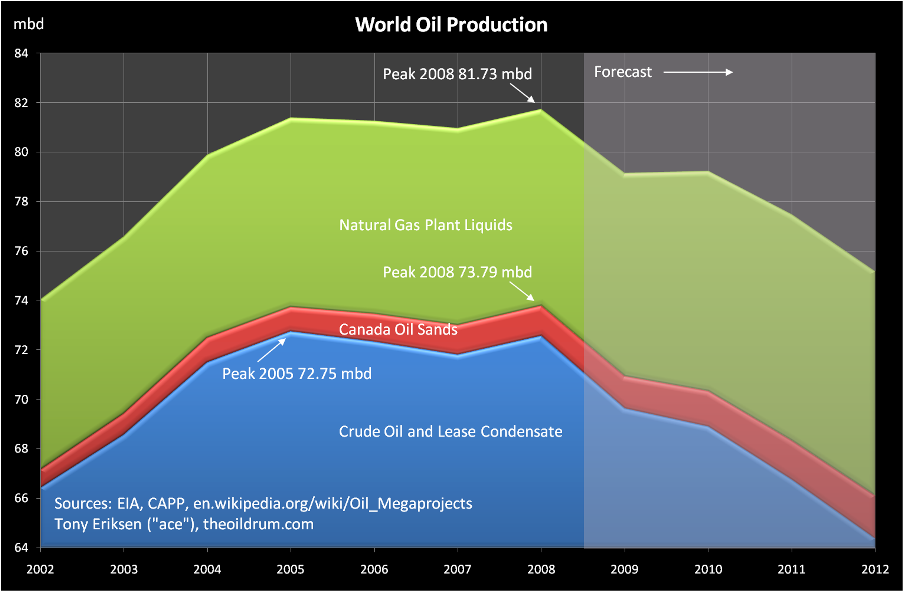
But to quote one of the great monsters of the twentieth century, Vladimir Ilyich Lenin, these ups and downs are of momentary interest. The real story of taking place in various inhospitable and mostly unpopulated locations around the world, some distance below the surface. At The Oil Drum where the editorial staff are usually a fractious lot, a staff survey shows that most agree World Oil Production Peaked in 2008.This is news that cannot be spun and brushed aside as something of secondary importance. The fate of our Industrial Civilisation can be read on the up and down slopes of this graph…click on it for a larger image