Showing posts with label peak oil. Show all posts

Monday, September 7, 2015

My thoughts on Naomi Klein and her speech: Capitalism and the Climate, Festival of Dangerous Ideas 2015

First, my character assessment of Naomi Klein who is (from Wikipedia) the "Canadian author, social activist, and filmmaker known for her political analyses and criticism of corporate globalization and of corporate capitalism". I think her heart is in the right place, she genuinely cares deeply for her fellow human beings and she is intelligent and articulate. She made a speech to the Festival of Dangerous Ideas several days ago which is below. I encourage you watch it, for its own sake and because it will better equip you to understand what I'm about to say.
Ms. Klein had some interesting things to say about how capitalism works its wonders in the world, particularly her description of the fate of Nauru, which is a comprehensive multifaceted human clusterfuck in microcosm, very illustrative of the ills of the System.

At the end of the speech is a question and answer session where in answer to the inevitable "But what can poor little us do, faced with such overwhelming horror etc?" she says, get in rooms full of people like you who want to do something about it. All very good, up to a point. And if we watch the Youtube clip above, we have indeed spent an hour in the company of Ms. Klein and mostly like-minded types (although the first question is from a climate change denier who seems so dumb, he must surely have been a plant in the crowd to get everyone a bit rowdier and on side), groping for understanding and solutions.

So accepting the motivations were good, the crowd was (mainly) adoring, and the exhortation to get cracking with like-minded others was fair enough, what was the problem? Well, it comes down to her vision of how the world works, as compared to how it actually works. Naomi sees the world being exploited by Capitalism, which is run according to her by nefarious characters, the cartoonish archetype being Rupert Murdoch, the Prince of Darkness, plus a supporting cast of lesser demons such as Tony Abbott, our esteemed Prime Minister, oil company executives and so on down the line. Whereas, if only us good-minded types were in charge, in a trice we could have the whole system running on renewables built by worker-controlled co-ops. Without her explicitly stating it, the answer is to get a revolution happening, have Rupert and his cohorts dangling from lamposts and then the chaps with wider necks than their heads who (in consultation, of course, with the scattered remnants of the Original Persons of each continent, with their Deep Understanding of the Spirits of the Earth etc) can get cracking with their lathes and welders knocking up wind generators and solar panels.

Her geography seems as woozy as her social modeling — she seemed to think the horror du jour, poor little 3 year-old Aylan Kurdi, was found drowned off the coast of Kurdistan. I think I'd be telling her agent not to bother booking any lectures in Turkey.

So what's wrong with this picture of the Problems of Capitalism? Well, I could launch into the analytical issues resulting from the over-simplified dualistic thinking which runs through Judeo-Christian culture and even back to Zoroastrianism. After pages and pages (with footnotes) we might get somewhere, with talk about how Weberian social analysis is a more subtle and useful tool than classic Marxism. Blah blah blah.

But suppose instead I postulate an alien ecologist, who makes a study of Earth and deduces the rules of human ecology are really no different from that of yeast. Yeast expands in its container until it uses up all the food source or is poisoned by its excretions. Then it dies off. Ditto humans — of course, we have some more complicated internal mechanisms than yeast, but the functional result is the same. Humans have leaders whose heads remain on their shoulders just as long as they can keep things organised enough to bring home the beef. Lately we've discovered this huge store of fossil fuel underground and boy, have we had a party! Now, as a result of this bonanza, there's billions of us, but boo-hoo, the energy is running out and it wont be replaced by chicken farts, extracting sunbeams from cucumbers or chopping the heads off the current captains of our destiny. There's way too many of us! As our alien scientist explains to the faculty back on Betelgeuse 9a, there may be all kinds of wonderful thoughts running through the heads of these human creatures, but they are beside the point when the model for the growth of yeast explains the whole thing!

As far as we know, yeast cells may be full of deep wisdom. Unfortunately I don't think Naomi Klein is, although I wish her well.

Sunday, February 23, 2014

So where to now? Who do we ask: David Holmgren, Jim Lovelock or Guy McPherson?

It's been a long while since I lasted posted. In 2012 I came to the end of long train of thought and exploration. My thinking has been changing in emphasis, but it's taken me a while to be able to articulate this change. So where am I and where are we, at the beginning of 2014?

It's obvious to me that we are in an accelerating process of decline of industrial culture. For a few years, dear little Australia seemed proof against the travails affecting the rest of the world, but now we too are on the big slide. All our automotive manufacturers have announced they will no longer build vehicles in Australia. One of our aluminium smelters is to close. Shell is selling its refinery in Geelong and its service stations. The Federal government is beginning to slash spending — no matter that it's a conservative government which is doing this — the same process would have taken place had the left-wing Labor party retained office. Tax revenues are declining and as unemployment starts to rise, the revenue from income tax and the goods and services tax (GST) will continue to fall and so the slashing will necessarily go on.

Of course the history of industrial culture has been a constant tale of birth, growth, decline and death of technologies, businesses and whole industries. But it has been a tale of growth  — "Progress" — which has seen living standards rise in general. Consequently the bulk of the population is loyal to the system. It has fed us all, so we send our children off to school to be indoctrinated, disciplined and turned into reliable employees.

Downturns in the economy have been periodic features of our civilisation for hundreds of years. Like an overgrown garden, we begin to choke on our own growth, there is a collapse and many businesses and occupations are swept away while new ones are thrust into being, now that new opportunities open up. Every downturn temporarily slows or stops growth, but every upturn which follows sees growth rebound to yet higher levels. This has lead to economic theories which ignore the constraints of natural resources. After all, we seem to have come up with substitutes every time some resource has become exhausted.

When Britain had cut down all its trees for energy, suddenly there was coal. When the limitations of coal became apparent — boom! — suddenly we had oil. An even bigger boom ushered in the atomic age which promised electricity too cheap to meter! Atomic energy fell a long way short of its promise but the cheap oil continued to flow, especially after the oil crisis of the seventies and the consequent rush to exploit offshore resources. Now that we are entering another downturn, brought on by the end of cheap oil, there will be another winnowing of inefficient, aging industries and occupations followed by a resurgence powered by…nuclear fusion? Windmills and solar cells? Zero-point energy? Algae farming? Unfortunately this time, the outlook doesn't look so good.

We now have a monstrously large human population which has been enabled — is in fact a consequence — of the cheap oil of the last hundred years. We are not going to return to business as usual powered by methane digesters running on chicken shit. We are in fact heading into a long, painful and bitter decline in which the human population will necessarily shrink back to something the planet is able to carry.

The mouthpieces of conventional economic wisdom with their constant chants of "returning to growth soon" are sounding more and more like the quacking of ducks. And we are experiencing a crisis of faith in our leaders.

This was all predictable years ago, when the implications of the peaking of conventional oil production world-wide and the consequent rise in oil price made the course of future events quite clear. My original intention with this blog was to blow the warning hooter: "Danger, danger, peak oil. Get ready people…" but now we are into the consequences and my warnings are somewhat beside the point. The question is now, What Do We Do? A subsidiary question must inevitably be, Who Should We Listen To?

On the up-and-up, everyone is fat, happy and full of love for their fellows and glad to give disinterested advice. On the downslide, things are different. Biases and special interests tend to come to the fore. People want to protect their family, their business, their community, their beliefs, their culture or their scam. It is important to develop an acute nose for these biases, because they can distort and devalue advice from even the most previously reliable gurus and sages.

First, David Holmgren. David has been a wonderful visionary and proselytiser for his Permaculture. As the crisis approached, he set up his peak oil web site, Future Scenarios, which had a big influence on me back in the day. David walks the talk. Recently he has published Crash on Demand which has caused a big stir in peak oil circles. I recommend you read Crash on Demand. David has reached something of a crisis, as many of us in the loose Peak Oil movement have. He sees that the industrial system has not crashed and is likely to become much more destructive as it fights for its survival. Remember we are all current members of this system! So his not-very-hopeful reaction is to call on aware, middle-class people who are interested in Permaculture to take the big step, disengage from the system as far as possible and maybe that lack of support will bring it down quicker, thus (maybe) saving us from the worst of the coming climate change.

So what is the problem with this? Some people are not at all happy with David's suggestions. Rob Hopkins, the genial mover behind the Transition movement, is unimpressed by David's abandonment of engagement with the powers-that-be at a local level: local government, unions etc. Others think he hasn't gone far enough. I think he's just doing what he knows best: being a responsible social activist. However I think being a responsible social activist at this point in history is a waste of time. Just because someone listens to you doesn't add up to effective action. David's remarks have stirred up the blogosphere but does that amount to anything? And at a practical level, would a small percentage of the global middle-class withdrawing their savings from banks bring down the system? I hardly think so! David has been prodded by something into making a stand outside his normal range. That's understandable, but it's important to realise that he is making his statements as a normal, private individual. I don't believe he has any more authority or special knowledge in this area than you or I.

On to Jim Lovelock. The grand old man of the Gaia hypothesis is a kind of living god, really. And he can grab the headlines, as in this Guardian online article. Jim has been an advocate of nuclear power for some time and has adopted a few contrarian positions, some of which I agree with. He doesn't appear to owe anyone any favours and so speaks his mind freely. And he's a nice man. But why the nuclear power advocacy? I think it's important to understand where Jim (and David Holmgren for that matter) are coming from. They are products of the academic system. They are highly educated members of the middle-class, however anomalous their current independence from that class's preoccupations appears to be. So at some level they want the part of the system which produced them to continue on — namely the university system. And that can only continue in a society which has the surplus to support it. Now I may be drawing a long bow here, but I'll stick with my opinion. Jim and David are talkers: that is their business as they see it.

This tendency or bias is much more obvious with people like Guy McPherson and his guest posters. Guy woke up from his academic slumbers, realised the game was up and went on a kind of intellectual rampage. Guy is basically an intelligent, good-natured fellow who is very angry. He has tried various alternative living arrangements but it hasn't been wildly successful. He feels trapped and has turned this into the most doom-laden viewpoint in the blogosphere. Humanity is screwed, the planet is a few years away from shrugging us off and there is nothing we can do about it. He has attacked Nicole Foss over a line from Nicole's voluminous essay on David Holmgren's Crash on Demand. His guest posters are pretty similar. The difference between Jim Lovelock and Guy & company is that the latter have given up all hope. They all worked so hard to climb the academic slippery pole, they out-studied the lazy and stupid ones, then arrived at the summit to find — desolation! Theirs is the tragedy of over-investment. Lazy swine (like me) dropped out early when we saw the game was rigged and went on to have a life.

So is Nature Bats Last right? Are we all screwed? A little early to say for humanity as a whole — I have my doubts — but I can say one thing for sure: we're all gonna die! It comes with the job of being a member of the human race. One other thing I'm reasonably sure of too: the academic world — as we know it — is toast. Sorry.

The best essay I've come across today is from Erik Lindberg. His essay is entitled Agency On Demand? Holmgren, Hopkins, and the Historical Problem of Agency. It's a long, thoughful piece at the end of which he says
Beyond this, I have very little to offer at this time.  I don’t know what I should do, nor how I should recommend my friends and family to act and react.
Great! Exactly how I feel. But I'm having a go, building a new house and workshop in town, looking around for a recession or depression proof business (who knows, something's got to work!) and smelling the flowers. Look, life is fuckin' hard! Evolution proceeds through the death of the unsuccessful and the breeding of the successful. But you can't live in the future (or the past). Life is now, the fleeting but endless moment before death. The future is made by people living and reacting in that moment: not by solemn committees composed of the cleverest and holiest of humanity deciding what's best for us all. We simply don't know enough to run anything but our own lives, for better or for worse.

 I distrust leaders, because I grew up with one. "Men are sheep. They need to be lead!" he would thunder. But leaders make sheep of us all.


Friday, June 8, 2012

Guy McPherson

I just came across this guy. He has a blog which I've added to my blog list. Check out his talk: it's dark but good…

Monday, February 20, 2012

In a nutshell…

At last in one place, the whole predicament explained! You may have seen this before but if not, check it out.

Saturday, April 2, 2011

Musings on social meaning and direction in a declining culture

I had an interesting experience on Thursday: my friend Fiona, who is a journalist on the local paper, rang me to say I should be at a park halfway between the town where I live and the one in which I grew up by just after twelve, in order to participate in some publicity for a stunt being run by Mercedes. Several cars running on hydrogen fuel cells are being driven round the world and this was to be a refueling stop for them. I turned up to find a great caravan of fuel trucks and support vans, necessary because places where you can top up your tank with hydrogen are pretty thin on the ground in South Gippsland.

So I chatted to various characters who were there. The cars came in and were refueled: we were promised a lunch but I had to miss out as I had a meeting to attend. What was striking was the size of the fuel trucks relative to the size of the vehicles. I had heard that hydrogen is a very bulky fuel and this will necessarily constrain any distribution network designed for it: essentially, it means it will work best for a dense concentration of vehicles close to a source of the gas, hence a city. To haul it long distances to outlets way out in the sticks won't work — the amount of fuel the trucks would consume would rapidly approach the amount they were carrying, and there are problems handling it too, due to its ability to leak through the tiniest orifice.

So I drove off musing on all this. The Mercedes people were full of enthusiasm for their project, needless to say, but is this the future of motoring? It could be the future of some motoring no doubt. Mercedes as a corporation may well survive the coming financial holocaust if their accountants are as smart as their engineers. Then they will be in a position to supply the elites in the cities with their clever cars, which have a range vastly greater than electric vehicles. But this is in no way the future of motoring for the masses. Because there can be no future of motoring for the masses.

Dmitri Orlov has just done a post at Club Orlov where he talks of the evolution of this phenomena: to quote…
…short-term political and financial trends point in an altogether different direction [from that of a continuation of the system-as-it-is]: that of the global industrial economy turning boutique. You see, one shoe has already dropped: the level of industrial activity that can be sustained today is already insufficient to provide anywhere near full employment and a reasonable quality of life for vast numbers of people; the solution is to disenfranchise them, to confiscate their savings, to cancel their retirements, to concentrate all of the remaining wealth in as few hands as possible, and to create a boutique economic and financial environment in which the lucky and unscrupulous few can continue to live comfortably…
As I said, if Mercedes plays this right, they may well have a future, providing for those who still have power and the money in the world. But don't be fooled into thinking that "alternative technologies" must necessarily be equitable, as well as "clean".

Monday, March 28, 2011

Australia looking down the Hubbert curve

Here's a part of an interesting post on The Oil Drum.
Australia is next on the list and it appears to have passed peak oil production and as a result, exports have dropped from over 500 kbd in 2007 to just above 300 kbd today. The declines in production are expected to continue.

"The recent start-up of BHP Billiton's Pyrenees oil field and Apache's Van Gogh field - both situated off Western Australia's north-west coast - will provide a boost in the short-term; however, the long-term trend is for production to keep falling," EnergyQuest Chief Executive Officer, Dr Graeme Bethune, said today.(this from April 2010).

Current production is at around 540 kbd, having fallen 40 kbd in 2010.

The decline with a projected drop of 85% in 10 years can be seen from this graph:
Anticipated future Australian production (Geoscience Australia)

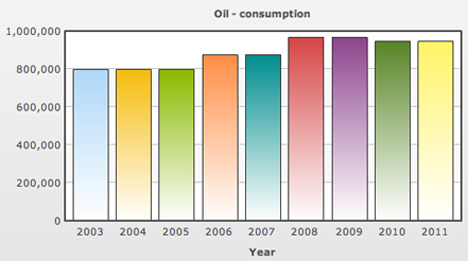
At the same time Australian consumption has been steadily rising, and is hovering just below 1 mbd.
Australian oil consumption (Index mundi)

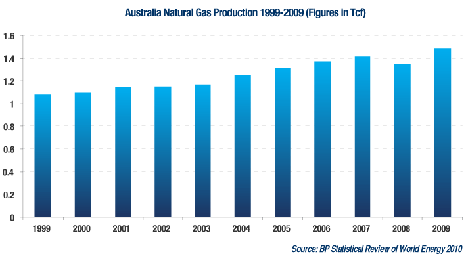
In contrast, Australian natural gas reserves are significant. As with Malaysia it has supplied LNG to Japan, starting in 1989 and has just signed a $41 billion contract for a 20-year supply of LNG from the Gorgon field, taking 2.25 million tons of the anticipated 15 million tons (0.75 Tcf) of annual production anticipated from the field, as overall gas production continues to rise.

Current estimates of Australian natural gas reserves are of over 108 Tcf
Commenter Jedi Welder notes
In the graph above, Australian crude oil production seems to be all but anihilated in just 20 years from peak production. That is a realy big fall. How will they cope with that?
Indeed.

Saturday, November 6, 2010

The True Faith

I'm talking about Science of course, or really its wildly popular but mentally subnormal child, Scientism. The believers in Scientism are generally the same people who believe in humanity's ever-upward climb towards perfect happiness and power — ok, we have the odd World War or financial hiccup, but everything will eventually get better and better, mkay?

The more paranoid fringe of Scientismists (I've coined a nice clumsy new term!), the sort who believe that George Bush bombed the World Trade Center because the Arabs weren't smart enough to organise something like that, tend to see conspiracies everywhere, except where they really are. Scientismists know deep down they're as dumb as dogsh*t, but that there are two types of smart people in the world, scientists and those evil bastards in the tall buildings. Scientismists believe in science, not as a system of inquiry, but as a reliable faith and the fount of all good things like iPhones and Prozac and Jumbo jets. They also tend to think like Ayn Rand: that the world is run by an incredibly smart conspiracy of evildoers who grab the ideas from the scientists and do what they will with them. Anything that disadvantages the powerful will be hidden away in some vast underground bunker. Like this wonderful invention that could let cars run on next to nothing! Watch this video!

What's worth noting is that no-one interviewing the guy asks where does the energy come from? And of course the designer, who knows what it is that he's made, just assumes that they know. But one comes away with the impression that these knob-heads think the energy comes from the salt water. All it took was a lone genius to see this! Just point radio waves at salt water and kaboom! Now watch the big energy companies suppress it!

Of course this is an American TV news spot and we know how ignorant a lot of those folk are. Not like Australia, where our ABC is rigorous in its scientific rectitude. But if you listen to people in this country talking and follow the political gossip you will soon realise that magical thinking and scientism is just as firmly embedded here — in control in fact — and that we are in no way especially intellectually privileged. For a start, who is talking about the fact that Australia imports 30% of its oil? We pay for it with our exports but how long can this go on? How do you think our economy will fair without that imported oil? Will electric cars magically appear? How about the parade of diesel trucks which carry the vast majority of our goods at some stage of their distribution? Will we get electric trucks too? And who supplies all this — Santa Claus? It is a dagger at the throat of our society, but no-one is talking about it! Instead all the talk is about the distribution of the goodies we have. The banks are greedy! No, they're the pillars of our economic strength! Houses cost too much because everyone wants one, but if you're smart, get in now and buy one because they always go up in value and you too can become a millionaire without working for it!

Most of us have very little understanding of how our lives really work. We're unaware of the vast investments in plant and institutions which so intricately underpin our daily life. All these complex arrangements are built and maintained by us, but we are conscious of only the tiny area we work in. For the rest, we deal in a kind of shorthand knowledge — a pseudo language which fools us and those we talk to, because it works. Until it doesn't. So house prices and stock prices go up and down and the trick is to know when to buy and sell, because stocks and houses have become almost purely gambling chips, the key to a future of living without working! Who knows what the stocks really represent? Because we all know we live in the best and luckiest country in the World and everything just gets better and better all the time because that's the Law of Nature, or something.

This spread of magical thinking has become the characteristic of our age, an age that began seriously in the nineteen-eighties. That's when somehow it seemed possible to spin something into nothing by talking the right talk. Young guys who had been nobodies only a few years previously suddenly had black clothes and cool haircuts and were driving new Porsches — rush hour to the eastern suburbs of Melbourne seemed to be jammed with them. The recession at the end of the eighties threw cold water on a lot of this for a few years, but it all popped up again in the mid-nineties and has powered on ever since. No-one makes anything, that's all done mysteriously, in China. Instead, we all work in service industries and the coolest thing is to be a celebrity, a chef or a footballer. And get a contract for a TV show. And spend enough on your credit card to get a free flight to Honkers and back. We just wish those dumb bastards in Afghanistan would see reason 'cause then they could live like us!

How long will it all last? One could argue that it will die when it doesn't work any more as a pseudo-philosophy. Of course it has never really worked, but over a short human life span it's possible to think all kinds of bizarre things and never have reality find you out. Only a very great trauma changes people's thinking and then usually only in those young enough to be receptive. I think scientism and its adherents will be with us for a very long time: even when it's obviously shot its bolt, like the Black Knight in The Quest for the Holy Grail, with all limbs missing its acolytes will think the corner will soon be turned and we'll be soon be back to Business as Usual.


Thursday, September 23, 2010

How do we really know collapse is immanent?

Aeldric has done a great post over at the Australia/New Zealand Oil Drum entitled The Networking of Resource Production: Do the Networks Give us Warnings when They are About to Fail? which goes straight to the heart of the problem I have: how can you tell in an unambiguous way that the system we are living in is approaching collapse? After all our human culture is full of legends of The End, replete with prophetic dreams, visions and revelations. If they line up with reality they get incorporated in legend and religious tradition. If they fail, which is vastly more frequent, they make page four in the newspaper under the "Quaint-goings-on-in-some-nutcase-cult" section: something a sharp student doing their Masters in psychology could use as a good subject for a thesis.

As an ordinary member of Industrial Society, what information do I have leading me to say a crash is immanent? What does an ordinary person "see" in their day-to-day existence which allows them to make these kinds of judgments? All of us have networks flowing through our lives but no-one can easily "see" these networks from start to finish or how they may relate to one another. We may understand our little bit very well and have a clear idea what is right and wrong with it. Our appreciation of other people's part is necessarily vaguer and tends to be tinged with the natural human suspicion that "others" are not as competent or hard-working as we and our colleagues. To quote from a comment Aeldric added to the discussion of the above post:
This is not helped by the fact that the problem is hidden by complexity. The people who say "We have plenty of resource X" are not just saying this to inflate the share price - they truly believe it. From their perspective, it is true.

The reason that low-quality reserves of resource X will never be extracted is only obvious when you look at the overall system.

Unfortunately, each entity only looks at their own area, the overall matrix in which we operate is treated as a "black box" that supplies our needs just as long as we continue to play our part. This faith in the system has worked thus far, but it is misplaced - we need to look at the overall system.
Add to that the seemingly exponential increase in complexity when doing anything (My wife and I are building a house and the planning requirements have two extra levels to surmount from the time I built my first: bushfire rating and energy rating which is part of a large engineering bill I didn't have before) and you have a world where everything seems micro-managed for efficiency and effectiveness, yet is all too complex for the ordinary person to control or understand more than a tiny part of their own life.

This situation is also governed by a time factor and a certain perception of "rightness". By "rightness" I mean that in Australia (at least for now!) there is a quite strong sense that we live in the best of all possible worlds, that everything is getting better and better incrementally, year on year, and the time factor means that even big changes often happen imperceptibly. So we have much better cars and sound systems, better roads, cheap international travel and the Internet which we can feel good about, while not noticing how much more difficult it is to buy a house and support a family than it was thirty years ago. We can be lulled by shiny novelties trickling into our lives while seeing our problems making our way in the world a lot of the time as "personal": that is, governed by our individual failings in a complex world where we are constantly struggling to find a role for ourselves. And strangely enough, this perception of struggle to be or at least appear competent increases amongst the more highly educated! As Jim Kunstler remarked in some context I now forget, if you go into any room full of educated people you can bet 90% feel that they are frauds.

Those of us who do want to understand the bigger picture must necessarily depend on abstract knowledge, of which we as a culture have a lot, but which in its sheer voluminousness and the difficulty in assessing its relevance poses yet another challenge. You can hardly blame the uneducated or moderately stupid for plunging headlong into dogma and cultishness which promise a shortcut to true knowledge, usually in the hands of a dubious leadership. Add to this the fact that certain professions such as economics suffer from alarming delusions and are just plain wrong in their very basis and it is little wonder that true knowledge of our real situation is limited to a very few. And even the knowledge of these few is very incomplete!

This is another reason why a political solution is simply not possible. Without the goodwill of a large proportion of the population no political party can push through a program which can address what is coming down the line towards us. And if only the tiniest minority of the population understands what is happening, how can that support appear?

Nevertheless there are people working on the problem in a rigorous and as far as possible, scientific way, so you can get reasonable quality information on what's happening. The problem is here that the phenomenon we are looking at is part of complex systems theory and therefore very difficult to quantify. So we depend on clever simplifications such as that posed by Aeldric in the article on The Oil Drum. But we still have to rely partly on less rigorous methods: "gut feelings" and intuitions which are very difficult to prove or even demonstrate to someone else. One of my favorite commenters on The Oil Drum is memmel but he drives some of the other regulars crazy, because his writing style is dyslexic and his ideas while having the ring of truth sound like a shorthand grab from a much more rigorous theorem which he never gives footnotes for. Here's an excerpt from his first comment:
I'd like to add what I came up with as the warning signal of collapse of a complex system in particular ours.
You have outline the overt signals but whats missing is what the system itself does to counteract the situation.
Indeed to the point that it obfuscates its real state.

What I believe starts to happen is the system plays whats basically a grand game of musical chairs. Its no longer capable of any real growth yet its forced to fake it.

A simple example is every job in Mexico or China results in the loss of a job in the US with a dramatic reduction in costs. No new job is created yet profit margins go up. For this to work obviously demand has to remain robust for the product of the job. Rising debt loads allow this to take place. In a real expanding economy wages would have risen rapidly in Mexico and China as they demanded they purchased the goods they where making. The wage arbitrage would have dissipated rapidly.

The same of course works for resources as well as labor the economy shifts to increase profit margins as constraints arise. Its a complex system thus a tremendous amount of shifting around is possible.

It becomes difficult to discern that its really just running around in circles and nothing is happening indeed only the explosion of debt really shows the underlying system has peaked.

As you note eventually everything becomes correlated with money and thus the final signal is in the financial arena. And its pretty simple its debt.

Next its worse than that really by the time the debt load grows to horrendous levels the system is well past its peak. This is because a lot of the debt was issued based on equity valuations supported by the previous debt expansion. Ever cheaper debt aka credit serves to support previous valuation rounds making new debt safe to issue.

So given that eventually everything gets correlated with money the signal that the system is now unstable is easy to see its debt. To understand how the system can pull off such a situation you need to look into this game of musical chairs or circular economics which eventually results in trading partners allowing debt to balloon.
Everyone has to reap real benefits even as the debt bubble expands. If now it won't expand.
This is done by allowing gains to be made on each individual transaction. Eventually of course it ends with central banks forced to carry tremendous amounts of debt in one form or another. The profits are of course skimmed off and the debt load is socialized.

On can actually construct a small variant of this. Consider a village where everyone works to build houses for each other. As each villager gets his house built by the village he owes the village for the house. Assume that resources are constrained and each house costs more than the last all paid for via credit back to the village which acts as the bank. Eventually the last house is built and its ten times the cost of the first house and the village owes itself immense sums of money as notational credit. Indeed many of the villagers that had their house built first are notational multimillionaires. Then what?
Do you see what I mean? Personally I love his comments because his intuitions have for me a ring of truth but I can understand people finding them repellent. But if we try to be more rigorous, dotting the "i"s and crossing the "t"s we end up with this, quoted from an article available here (warning, it's a pdf):
The theoretical basis of the work on early-warning signals in simple models is quite strong, and the first results from more elaborate models suggest that similar signals may arise in highly complex systems (23). Nonetheless, more work is needed to find out how robust these signals are in situations in which spatial complexity, chaos and stochastic perturbations govern the dynamics. Also, detection of the patterns in real data is challenging and may lead to false positive results as well as false negatives. False negatives are situations in which a sudden transition occurred but no early-warning signals could be detected in the behaviour before the shift. This can happen for different reasons. One possibility is that the sudden shift in the system was not preceded by a gradual approach to a threshold. For instance, it may have remained at the same distance from the bifurcation point, but been driven to another stable state by a rare extreme event. Also, a shift that is simply due to a fast and permanent change of external conditions (Box 1 Figure a) cannot be detected from early-warning signals.
And so on for many more qualifying paragraphs. I think memmel is easier!

In the end we have to make decisions about our lives based on hunches and intuitions as much as anything. It doesn't hurt to have some solid theoretical backup but that can be wrong too! I guess my gut feeling is that a collapse of the US economy is not far off: maybe one or two years. How that will play out in Australia is much more difficult to say as we are tied very closely to the Chinese and Japanese economies and how they will fair is open to question, seeing both are very export oriented at a time when the importing economies, namely the USA and the Eurozone are wobbling badly. And as at my public lecture in October 2008, I stated Australia was importing 1/3 of its oil needs and that proportion has remained the same (choose Australia from the drop-down menu to display).


Saturday, October 31, 2009

Cross-posted interview

The interview I talked about in my last post between Stoneleigh and Euan Mearns is cross-posted at The Oil Drum, so you can read the always intelligent discussion of it by TOD people as well.

Tuesday, October 13, 2009

Transition Town blog for Corner Inlet district

Fiona Mottram and I have set up a new blog, Transition Corner Inlet, which will be a vehicle for communication about transitioning to a low energy/low CO2 future. Our first function will be a film, The Power of Community: How Cuba Survived Peak Oil, which will be screened next week at Foster Community Health Centre on Thursday October 22 starting at 7.00pm.

I'll keep this blog going as my personal take on the world, but the new blog will be a communal effort.

Wednesday, September 30, 2009

Maribyrnong City Council Peak Oil Contingency Plan

Phil Hart has posted an article on The Oil Drum about this initiative for the Maribyrnong City Council Peak Oil Contingency Plan (warning: PDF) with which he has been involved. It's well worth a read. The comments are worth a look too (as they usually are at TOD). In the comments there's a link to an article about the Shire of Yarra Range's attitude to the same question. Here's the vital quote…
But councillors Richard Higgins, Graham Warren and Chris Templer disagreed, saying it wasn’t council’s responsibility to plan for such contingencies.

They believe it should be a State or Federal Government issue.
Shouldn't we all just wait for Daddy to look after us?

Let me just say that when the tide rises it lifts all boats, but when it sinks only those who make it to the channel can float. We South Gippsland people live in the State electorate of the leader of the National Party in Victoria (the conservative former Country Party), Peter Ryan, and we also live in a Federal electorate represented by Russel Broadbent, a member of the Liberal Party (also conservative, you foreigners!). Both these gentlemen are in opposition to their respective governments. Neither are likely to get a bone tossed to them by their political opponents.

So as far as I'm concerned, the Lord helps those who help themselves. We have already seen how the government in Melbourne works when those closest to it (electorally) are threatened.

Monday, September 14, 2009

Left or Right wing — what difference will it make?

Our government in my state — Victoria — and federally is Labor, nominally left-wing. Will it matter in the longer term whether right or left wing parties dominate politics? Supporters of both sides hope that it will matter and hope their side will win, which is perfectly natural. But I wonder whether it will make a lot of difference in the long term. I'll concede it does in the short term. I was very glad to see the end of John Howard and his gang. I wish the new lot were less like him than they are. I'll admit it — I'm a soft, left leaning libertarian who wrote letters to the papers deploring the treatment of asylum seekers and the rush to support George W Bush in whatever international adventure he was involved in. But in the longer term, maybe it doesn't make as much difference as we would like to imagine.

Politics is the froth and bubble on top of society. It is the way power and resources, which are scarce, are apportioned to an infinite demand. Underneath however are the hidden trends which really control our lives and most often they are not the product of politics. Politicians of all stripes are "successful" when they surf the wave of prosperity, the way Maggie Thatcher surfed the wave of growth which resulted from the huge bonus North Sea oil gave to the British economy. In Australia, Malcolm Fraser and the Liberals (conservatives to you non-Australians: we're upside down here at the bottom of the world) reaped the whirlwind of the recession of the late seventies, while Labor under Bob Hawke were the beneficiaries of the boom brought on by a world awash in cheap energy in the eighties. Dmitri Orlov has it that the same cheap energy destroyed the Soviet economy which was dependent on oil exports to maintain the system, thus leading, at least in part, to the collapse of the Soviet system at the end of the eighties.

Peak Oil is not a political issue, it's a geological one. The same goes for all the looming shortages which nature is shortly going to impose on us freely breeding humans. Politics may matter to you and me in our immediate time and place, but in the longer term, which is not much longer these days, these larger, hidden issues are going to take charge of our lives in uncomfortable ways.

Tuesday, September 8, 2009

Talking at the Green Door

I'm giving a talk on Peak Oil at the Green Door Cafe & Produce Store, 29 Bridge Street, Korumburra this Thursday at 6:00 pm. Call them on 03 5655 2351 or email karen@greendoorcafe.com.au for more info.

Friday, September 4, 2009

Important post on The Oil Drum

This is a pretty important post on The Oil Drum concerning how we in Australia will deal with a reduction in fuel availability. Please read it! A quote from the conclusion…
I hope these thoughts encourage you to consider the local and personal angles and think about what you and your family would be able to do. Good general advice is perhaps to buy a sturdy bicycle, get to know your neighbours better and ponder about how you can get around with much less fuel.
All very well for those city dwellers with a reasonable public transport system. Wot about us country folk eh? No rail to our area, only diesel powered road freight deliveries. Ulp!

Thursday, August 20, 2009

At the limits of the possible

Tight budget quashes US space ambitions: panel is the headline for a story from Space-Travel.com which landed in my in-box this morning. President Obama has commissioned a panel, which has produced a report laying out the reality of the costs involved in manned space travel versus the likely budget allocation. Here's a snip…
Reaching Mars was deemed too risky while returning to the Moon by 2020 was ruled out barring an additional three billion dollars per year to replace the retiring space shuttle fleet and build bigger rockets, according to the group led by Norm Augustine, a former CEO of US aerospace giant Lockheed Martin.

The problem is not the just the will to do manned space flight, it's the money. You need a lot of reliable finance for a manned space program, because it takes many years to develop and the people have to be recruited, trained and paid to stay there. They need confidence and continuity in order to do their best and you need the best kind of work from such people, because to quote Tom Wolf from The Right Stuff, "It can blow at any seam!". This is why the Chinese could be on a roll at the moment with their manned program. They have a certain stability and predictability due to their dictatorial political arrangements. At the moment they're likely to do better than the Americans over the next few years if their technical people are up to scratch and the leadership of their program is good.

But in the end we are all hostages to the environment we live in. Some may push out further along a certain path than others, because they can cooperate better or are more amenable to discipline. But no-one can live on nothing, and the Chinese are likely to discover their limits are not too far away either, because the manned space enterprise rests on the back of industrial civilisation in general, which in turn is hostage to cheap oil.

We now appear to have crossed the bumpy summit of peak production in oil sometime in the last couple of years and to be standing at the top of the long slope down. From now on oil will be available, but not affordable in the way it has been, and this will undercut the assumptions which have underpinned our growth economy and our ever expanding world population. The surplus wealth and energy at the command of large organisations, which is necessary for exuberant adventures such as manned space flight, will not be there for much longer.

This is a tragedy of a profound kind. It means we are likely now to remain forever on Earth until we, meaning humans firstly, and then terrestrial life in general, goes extinct. We had a tiny window of opportunity but we missed it. Maybe the step was always too big. While us space nuts could wheel out all kinds of blue-sky designs which could theoretically get us not just off Earth and on to our local planets but beyond to more distant stars, the cost was always going to be phenomenal. We almost had the chance at the beginning of the seventies, but once public interest in the whole enterprise waned after the initial Moon landings and we lost ourselves, in the words of James Howard Kuntsler, in dark raptures of personal consumption and non-stop entertainment, the opportunity slipped from our grasp.

The Space Shuttle is a triumph of sorts, more over a basically poor design than of anything really useful. To quote again from the article I mentioned at the beginning…
The White House could take months to decide its course of action, said John Logsdon, former director of the Space Policy Institute at George Washington University.

"We have inherited one of the many failed promises of the Bush administration -- to set out a very good program without providing the resources to fund it," he told AFP, urging a new direction.

"We have lived an illusion for five years."

The US space shuttle program and the ISS, he said, "were a mistake" when compared to the Apollo Project that landed man on the moon for the first time.
The unmanned commercial exploitation of space will continue for a few more decades and will return its shareholders money on their investments. There is a faint possibility that a manned program could grow out of it, but it is very unlikely, simply because manned flight is orders of magnitude more difficult than unmanned.

Isn't it an extraordinary thing though, to live at such a moment in world history when we are wheeling through the very outermost limits of what was possible. Of course our appetites are always well beyond our capabilities. But what a dream it has been and how difficult it will be to let it go.

Wednesday, August 19, 2009

Planning day at CERES

I nipped up to Melbourne for the day yesterday as I'd been invited to a planning day at CERES, the Centre for Education and Research in Environmental Strategies, in Brunswick. CERES is planning for the next five to ten years taking into account what we face as a result of Peak Oil and climate change, especially the social needs which will arise. It was great to spend a day with twenty people who talked about what I think about! And thanks to Serenity Hill and Kirsten Larsen from the Australian centre for science, innovation and society at Melbourne University who dobbed me in as a participant.

Despite my wife running a nursery in Foster I'm no plant guru, so my contributions were restricted to the social aspects of the future. David Holmgren was there with his partner Su Dennett and briefly sketched in his future scenarios which we worked off. Then we broke up into small groups and came up with our plans.

The day went very quickly and I had to head off at the end of it to do some business for the nursery which meant I didn't get a chance to talk to the very many interesting people there other than Serenity, Kirsten and Chris Ennis, the Manager of CERES Organic Farm and Training. What the day did do is confirm my belief that the inner urban parts of Melbourne are probably going to to do reasonably well with the changes we are now in — they have a critical mass of bright, committed people with enough power in their hands and the right priorities to steer their communities in useful directions.

Monday, August 3, 2009

A moment of reality from the mainstream

From an article in the business Age…
World faces 'oil crunch' within five years
August 3, 2009 - 11:15AM
A disastrous energy crunch is looming because most of the major oil fields in the world have passed their peak production, a leading economist has warned.

Fatih Birol, chief economist with Paris-based International Energy Agency (IEA), said such an ''oil crunch'' within the next five years could jeopardise recovery from the global recession.
Of course the problem is still some way off according to Fatih Birol…
[with] global production likely to peak in about 10 years - at least a decade earlier than most had estimated.
Actually global production appears to have already peaked, but never mind. This article picks up an interview in the "Independant" and has caused a stir in the mainstream media across the world. There's a great post on The Oil Drum about it: check it out, especially the comments.

What does it all mean? It means you've been warned folks. This is real and coming to your town very soon. Of course within a day or so the article will have been forgotten and we will slip back into the well of forgetfullness if we drink too deeply at the well of mainstream media. But the clock is ticking.

Last year at my public meeting I said five years for Australia, before we face the end of oil based prosperity. Only four years to go now.

Thursday, July 23, 2009

The Carbonic Civilisation & its Discontents

Various legislative bodies around the World are busy pushing out laws which are meant to address the issue of greenhouse gases. How effective these laws are will be inversely proportional to the wealth of the country each legislature controls. This is because people are very bad at sawing off branches they happen to be sitting on.

Us ordinary folk may labour under the delusion that technology can solve any material problem. We see glossy pics of electric cars and solar panels, and imagine the only thing stopping the adoption of low-carbon technologies are some fossilised politicians and industrialists. But this is not so. The real brake on cutting carbon dioxide outputs are tens of millions of families with 2.4 kids, two cars, a hefty mortgage and orthodontists bills. The real costs will be very high for such folk, which are a lot of the people we know.

Why? Because you may recycle your plastic, not waste water, buy organic and do all the things we are told to do, but there is a whole lot of stuff "out the back" in the industrial suburbs of every city which has to operate on copious fossil fuels in order that we can live our lives, and this stuff — the factories, warehouses, freeways, waste treatment plants, hospitals, offices, roads, mines and railways — are expensive to rebuild and will take a long time to change. "Expensive to rebuild" means we must find the time to rebuild them. Either that or we must work to pay someone else to do it. And that assumes it is possible to rebuild them in a more benign form, which in many cases it is not.

We've just had a big materialist binge over the past few years, where the cost of the stuff we use has been kept artificially low because the Chinese have paid their workers a low wage to build it. That situation cannot last. We will soon go back to paying the real cost of living. This will mean less money to change our built environment to a less carbon intensive arrangement. Add to that the decline in oil availability and we have a real problem.

And then there is the unspeakable, uncomfortable truth that lies under all this — there are way too many people on the Planet. How are we voluntarily going to reduce our population to something more in line with what the Earth can support?

The truth is that we are animals like any other on Earth. We expand to fit our environment and then some. We want more, usually not much more, just that little bit, even the richest amongst us. Do you know anyone who wants less? No, I didn't think so!

We've expanded very successfully until now. Of course we always have Problems. And we always have earnest people, experts, discussing and proposing Solutions to these Problems. These Solutions, strangely enough, always need More of something. More spending on health care, education, law and order, supervision of industry. Surely a solution to the crises looming over us at the moment is a lot less of everything? People, cars, cows, strip mining, commercial fishing, driving, flying — well, make your own list!

But of course having a lot less means things get very tough for the great mass of people with the 2.4 kids, cars etc. They need to work to pay for their lives, they vote, or even if they don't, they can make trouble for the People In Charge. And of course we all want the world to be better, we just don't want it to be at our expense. Let the less worthy pay! So we will see the hunt for people to blame — scapegoats — intensify. But of course all that is in vain if the problem is all of us.

So what is my Solution? Well, it's in several parts.

Firstly it's your problem so you've got to solve it! OK, you didn't choose to be born, but can you tell me the name of anyone who did? So get over it — you're in charge of your life.

Secondly a lot of us, maybe most of us, don't feel we're really up to scratch in a lot of ways. We'd love to be told by some competent person what to do. We believe in experts. Well guess what? Experts are often wrong! And the more they say they know and the less you do, the wronger they tend to be. Sure, listen to what people say. But an honest heart and an open mind is of more value than believing any appearance of certainty. This may mean you run against the tide of opinion a lot of the time. Learn to deal with it. You don't need to broadcast your contrariness. But practice the courage of your convictions in small ways, because one day you may need to find it for something big.

You will come across people who believe that the world was made for the use of themselves in any way they see fit, and others who will tell you the human race is a blight on creation. Avoid these types — they are both expressions of arrogance, in that they make value judgements which no-one can truly make. And both attitudes lead to trouble.

The world will re-adjust to make everything right again. Nature has a way of dealing with these problems. Those who best protect themselves from what is coming will part of the future of life on Earth. Let that be a guide for your actions.

I don't think we can do anything at a world-wide or even nation-wide level about the greenhouse problem because of the pressure of population and the prior investments we have in our industrial civilisation. So we will have to deal with the consequences of dramatic climate change over the next few decades. That's the way it is folks. Just think about how you and those closest to you can survive the coming changes. Forget about survivalism and Mad Max scenarios. Most people will survive or die where they are, dependent on the conditions in their local area. So for a start, understand where you live, how it works, how people survive in it now and how they and you might survive in the future. If it doesn't look good, move to somewhere better while you can!

Understand how nature works. Darwinian selection works through the survival and reproduction of the fittest. That doesn't mean the ones who can win races, it means the ones that fit the best into their environment, who can gain sustenance, shelter and safety without wrecking where they live.

We are used to seeing ourselves in a very upwards and outwards way. I'd say the dominant story of our civilisation for the past sixty or so years has been "Everything will be fine once we get the settings just right and all those other people learn to behave themselves". But unfortunately that just isn't so, and we are going to be flung into a world soon where we wont necessarily have any idea of what's coming next. We'll be reacting to crises right on our doorstep, not trying to make the Afghans or the Somalis jump when we say jump. For a lot of us this is going to be a bitter pill to swallow. So preempt the change and embrace your inner powerlessness now! Just concentrate on what's close by and attend to its needs: self, family, community and the enclosing natural environment. Forget saving the world-as-a-whole. That's always been a totalitarian dream powered by cheap fossil fuel.

The hard part for many of us who wake up to what's really going on is we can feel very isolated. If our Significant Other doesn't share our new view of reality, what do we do? I don't know what the answer is here other than patience and good humour. Reality will impose itself on us all eventually. Your job is to make sure you're as right as you can be. Not that anyone predicting trouble gets thanked for it, but speaking from a little experience in these matters, time is on your side with this.

What do you tell the children? I have my way with this one too, but it may not be for everyone. I have four children, two of them step-children, the oldest of whom is thirty-four. My attitude has always been that children make their own way in the world and what you need to do is keep them safe, well-fed, emotionally secure and don't let them get away with bad habits. Everything else they will pick up themselves. If you push them in a particular direction you will get adults who either will do nothing unless they're pushed, or adults who believe in pushing other people.

I've been very lucky so far with how things have turned out, but I'm aware that it is luck and not good management. The problem is, if you do something to assure success, like spend a fortune on private tutors, all you do is create someone who can't live outside that sort of system. To my way of thinking the best you can do is let children grow up in an environment which is healthy, with not enough money to get them into trouble but enough to keep them fed and give them a few basic tools for their growth. As long as they don't feel crushed by the society they grow up in, or that they are too good for it, things are generally alright. As for us breast-beating about how we elders have squandered the inheritance and left them nothing, give it a break! The last thing anyone needs is an excuse for failure and by saying something like that, you will produce either arrogance (I'm not as stupid as the person telling me this!) or a victim's mentality (I'm one of you and therefore I'm doomed too!) in a child who isn't sensible enough to say "Phooey!" to you.

Education is important but I can't say that it is necessarily effective to spend twelve or more years sitting at a desk. Looking at the corner we're busy painting ourselves into with our mighty civilisation, one needs to question some of our basic notions here. It may become more difficult to fund in the future in any case. Opportunity is the most important thing, plus the ability to take advantage of it, which involves such things as good health, common sense and a lack of timidity. Character is something which matters more than just about anything and it matters a great deal when you're younger. And character is what will distinguish the survivors from the doomed in the next, difficult stage of our history — providing they are in the right place!

The next pillar of survival is community. We ordinary folk will find it much easier if we're part of a real community. Communities are the normal human social arrangement, but they have not fared well in our industrial world which demands loyalty to abstract functions and specialisations, and prefers humanity to be broken up into single, bite-sized functional units for easier deployment to places of highest profit. The Soviets did it by force, through murder and deliberate starvation in the nineteen-twenties to break up the village structure of the Soviet Union. Our more modern societies have done it through education (get the children away from their parents and environment) and propaganda (most advertising), and by driving local, small businesses under or by making them into empty shells, fronts for a franchise. All this has so undermined community that in many places it is vestigial, especially in big cities. As a natural human artifact, it is forever being rebuilt. But building community takes a long time, generations in fact, so in the face of the rapidity of the changes we're facing it's better to find one already in existence. I've had some experience of intentional communities (I'm an old hippy) and they tend to be unstable for a variety of reasons. So I don't recommend cults or communes unless they are embedded in a larger functional community and have good relationships with it.

The final step is for us industrially disabled types to throw away our crutches. Learn to walk or ride a bike — leave the car at home — grow some of your own food, talk to your neighbors, get involved in the work of your local community. Don't be like a little bird, lying back helplessly with your beak open, squawking and waiting for Big Daddy to drop something into it. Cause Big Daddy wont be there much longer.

The solution to the greenhouse problem of carbon dioxide will be a radical fall in its production by individual people, and this is going to happen not by executive fiat, but through the uneven collapse of the great industrial civilisation which has been built up on the back of the copious use of fossil fuels as these fuels stop being affordable to the great bulk of us. The cheap stuff has all gone, and the expensive stuff is too expensive to keep the wheels spinning. We will have wars for resources and people saying we've turned the corner and that new technology will save us — it's only five or ten years away! It's always just five or ten years away.

But the show is over. It will appear to run in for years, as the elites who manage to command remaining resources claim that everything has returned to normal and those who aren't benefiting have only themselves to blame, but that's the age-old story of the relationship between the haves and have nots. Forget alternative energy. It will provide only a tiny fraction of our energy. It simply costs too much compared to dirty old oil and coal.

Will life be worth living? Of course it will! This is an amazing time to be in. We have lived through and seen the peak of the greatest civilisation the World has ever known, and we get to decide how to deal with its dissolution and the shape of what comes after it. It would have been nice to have flying cars and holiday trips to the Moon, but there's still plenty of other good things to enjoy: wine and love, children, good friends, food, music. Have fun!

Cheers!

Lloyd