Thursday, March 31, 2011

Good James Howard Kunstler interview & a great primer on the GFC

JHK has only one tune in his repertoire but he plays it damn well. Here's an interview on Terrain.org (a journal of the built and natural environments) where he spins it all out in fine form — lots of quotable bits including this: "We will do what reality compels us to do, not necessarily what our fantasies propose." My sentiments exactly.

My friend Mike sent me a link to a broadcast which gives a background to the current financial crisis — if it puzzles you in any way, give it a listen! It makes very clear the motivations of players at every level. Highly recommended.

Tuesday, March 29, 2011

The passing of a master

Joe Bageant is dead. He was the chronicler of his people, the rednecks of the American Scots-Irish underclass, whom he loved but for whom he despaired. Read his stuff: Deer Hunting with Jesus: Dispatches from America's Class War and Rainbow Pie.

Monday, March 28, 2011

Australia looking down the Hubbert curve

Here's a part of an interesting post on The Oil Drum.
Australia is next on the list and it appears to have passed peak oil production and as a result, exports have dropped from over 500 kbd in 2007 to just above 300 kbd today. The declines in production are expected to continue.

"The recent start-up of BHP Billiton's Pyrenees oil field and Apache's Van Gogh field - both situated off Western Australia's north-west coast - will provide a boost in the short-term; however, the long-term trend is for production to keep falling," EnergyQuest Chief Executive Officer, Dr Graeme Bethune, said today.(this from April 2010).

Current production is at around 540 kbd, having fallen 40 kbd in 2010.

The decline with a projected drop of 85% in 10 years can be seen from this graph:
Anticipated future Australian production (Geoscience Australia)

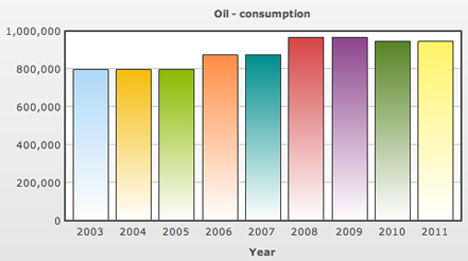
At the same time Australian consumption has been steadily rising, and is hovering just below 1 mbd.
Australian oil consumption (Index mundi)

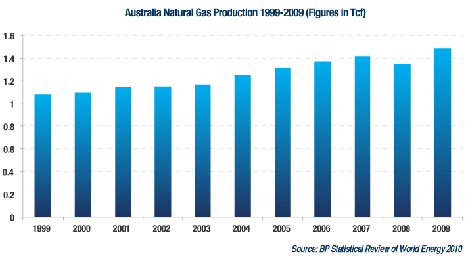
In contrast, Australian natural gas reserves are significant. As with Malaysia it has supplied LNG to Japan, starting in 1989 and has just signed a $41 billion contract for a 20-year supply of LNG from the Gorgon field, taking 2.25 million tons of the anticipated 15 million tons (0.75 Tcf) of annual production anticipated from the field, as overall gas production continues to rise.

Current estimates of Australian natural gas reserves are of over 108 Tcf
Commenter Jedi Welder notes
In the graph above, Australian crude oil production seems to be all but anihilated in just 20 years from peak production. That is a realy big fall. How will they cope with that?
Indeed.

Tuesday, December 7, 2010

Wikileaks is a watershed

Julian Assange has ignited a firestorm amongst the thinking classes. He is driving a wedge between the establishment and the general run of the intellectual class who work the levers of our modern industrial/financial world. This has grave consequences for the legitimacy of our rulers. Julia Gillard has had the approval of the US establishment, but is fast losing support at home because of her reflexive anti-Assange statements.

As Ran Prieur says in his December the ninth post, it doesn't matter who Julian Assange really is any more because he's become a myth, an enabling story that allows us (the intellectual class) to construct the narrative of our time. When a culture is on the rise, it's relatively easy for leaders to manage their business and to maintain the Mandate of Heaven. On the downward side — which we are now on, although it may be some years before this is widely acknowledged by the intellectual classes let alone the general public — problems multiply like the heads of the Hydra. It is an unfortunate time to be in charge of anything. The compromises one must make to reach the top of the greasy pole are becoming impossible to maintain. In such a time, uncompromising types like Assange find their opportunity. The times in a sense call out for them. A few years ago David Hicks had a similar chance to play this role but the time was premature and he was too shallow a vessel to carry the load, unlike Assange.

In a world of six billion people, where the dominant culture has reached the limits of its power and is starting to lose its grip, the tensions thus produced must find their expression through the lives of individuals. This is Julian Assange's fate. He has prepared himself for it and will no doubt acquit himself courageously enough according to his own values. The longer term significance is impossible to assess. But after he is gone there will be others, for better and worse. All types of people who have ever existed are out there — Christs and Hitlers — and in every crowded city these individuals are waiting, hoping their time has come.

Assange's writings are vague, overly-simple and fairly one-dimensional to my mind. He is not the new Messiah, although I have a feeling he'd like to be. But we'll see what he comes up with. And more importantly, what is made of him.

EDIT: The Archdruid in his latest post skewers the ruling elite more effectively than I can:
The elites that mostly run today’s industrial societies, like their equivalents in every other human society, have a deeply conservative streak under whatever surface layer of fashionable radicalism may be popular at any given time. They have the positions of influence that they do because they have the educations, hold the opinions, and think the thoughts that their peers, and more particularly the immediately prior generation of their peers, considered suitable to their roles. In a society that’s more or less sustainable, this is a powerful source of stability; in one that’s stumbled into an unsustainable human ecology, these same pressures for elite conformity can make it next to impossible for anyone in charge to think about the world in any way other than the one that’s making disaster inevitable.

2nd Edit: Ran's added a permalink for his Assange post so I've modified the link on his name above.

Wednesday, November 10, 2010

The moral issue of now

Ran Prieur has a post which encapsulates the issue we in the industrial world face: the irrationality of our desires. He says…
My favorite election commentary is by Sharon Astyk: The election is over - Now what do we do with all the fear? I agree: the voters are not really idiots -- they are cowards, and using their human brainpower to convince themselves of fantasies that defy both reason and observation: that the government can dispense benefits without collecting taxes; that an economy based on exponential growth can continue on a planet of fixed size; that we can have utopia merely by filling the slots in the present system with different people. What they're afraid of is reality: that the government, the economy, the planet, cannot continue to give more than they get, that all the stuff we've been getting, we're going to stop getting.
If we expect Santa Claus (ie the great god of industrial civilisation) to bring us goodies endlessly while we have no appreciation of the costs, we will react with infantile rage when our desires are frustrated. And who will we blame? Refugees? Indians? Moslems? Jews?
After they lose their toys, the people will be hungry for leaders who call for the sacrifice of others, and I mean sacrifice in the literal sense: the ritual mass-murder of scapegoats. When there are piles of bodies in the streets, only then, from the sane fringes, will new and better systems grow to fill the dead spots.
And what will trigger this rage in Australia? My guess is a big collapse in real estate prices, brought on by a downturn in China which will slow our export bonanza. I hope it doesn't get as bad as Ran posits, but you never know.

Saturday, November 6, 2010

The True Faith

I'm talking about Science of course, or really its wildly popular but mentally subnormal child, Scientism. The believers in Scientism are generally the same people who believe in humanity's ever-upward climb towards perfect happiness and power — ok, we have the odd World War or financial hiccup, but everything will eventually get better and better, mkay?

The more paranoid fringe of Scientismists (I've coined a nice clumsy new term!), the sort who believe that George Bush bombed the World Trade Center because the Arabs weren't smart enough to organise something like that, tend to see conspiracies everywhere, except where they really are. Scientismists know deep down they're as dumb as dogsh*t, but that there are two types of smart people in the world, scientists and those evil bastards in the tall buildings. Scientismists believe in science, not as a system of inquiry, but as a reliable faith and the fount of all good things like iPhones and Prozac and Jumbo jets. They also tend to think like Ayn Rand: that the world is run by an incredibly smart conspiracy of evildoers who grab the ideas from the scientists and do what they will with them. Anything that disadvantages the powerful will be hidden away in some vast underground bunker. Like this wonderful invention that could let cars run on next to nothing! Watch this video!

What's worth noting is that no-one interviewing the guy asks where does the energy come from? And of course the designer, who knows what it is that he's made, just assumes that they know. But one comes away with the impression that these knob-heads think the energy comes from the salt water. All it took was a lone genius to see this! Just point radio waves at salt water and kaboom! Now watch the big energy companies suppress it!

Of course this is an American TV news spot and we know how ignorant a lot of those folk are. Not like Australia, where our ABC is rigorous in its scientific rectitude. But if you listen to people in this country talking and follow the political gossip you will soon realise that magical thinking and scientism is just as firmly embedded here — in control in fact — and that we are in no way especially intellectually privileged. For a start, who is talking about the fact that Australia imports 30% of its oil? We pay for it with our exports but how long can this go on? How do you think our economy will fair without that imported oil? Will electric cars magically appear? How about the parade of diesel trucks which carry the vast majority of our goods at some stage of their distribution? Will we get electric trucks too? And who supplies all this — Santa Claus? It is a dagger at the throat of our society, but no-one is talking about it! Instead all the talk is about the distribution of the goodies we have. The banks are greedy! No, they're the pillars of our economic strength! Houses cost too much because everyone wants one, but if you're smart, get in now and buy one because they always go up in value and you too can become a millionaire without working for it!

Most of us have very little understanding of how our lives really work. We're unaware of the vast investments in plant and institutions which so intricately underpin our daily life. All these complex arrangements are built and maintained by us, but we are conscious of only the tiny area we work in. For the rest, we deal in a kind of shorthand knowledge — a pseudo language which fools us and those we talk to, because it works. Until it doesn't. So house prices and stock prices go up and down and the trick is to know when to buy and sell, because stocks and houses have become almost purely gambling chips, the key to a future of living without working! Who knows what the stocks really represent? Because we all know we live in the best and luckiest country in the World and everything just gets better and better all the time because that's the Law of Nature, or something.

This spread of magical thinking has become the characteristic of our age, an age that began seriously in the nineteen-eighties. That's when somehow it seemed possible to spin something into nothing by talking the right talk. Young guys who had been nobodies only a few years previously suddenly had black clothes and cool haircuts and were driving new Porsches — rush hour to the eastern suburbs of Melbourne seemed to be jammed with them. The recession at the end of the eighties threw cold water on a lot of this for a few years, but it all popped up again in the mid-nineties and has powered on ever since. No-one makes anything, that's all done mysteriously, in China. Instead, we all work in service industries and the coolest thing is to be a celebrity, a chef or a footballer. And get a contract for a TV show. And spend enough on your credit card to get a free flight to Honkers and back. We just wish those dumb bastards in Afghanistan would see reason 'cause then they could live like us!

How long will it all last? One could argue that it will die when it doesn't work any more as a pseudo-philosophy. Of course it has never really worked, but over a short human life span it's possible to think all kinds of bizarre things and never have reality find you out. Only a very great trauma changes people's thinking and then usually only in those young enough to be receptive. I think scientism and its adherents will be with us for a very long time: even when it's obviously shot its bolt, like the Black Knight in The Quest for the Holy Grail, with all limbs missing its acolytes will think the corner will soon be turned and we'll be soon be back to Business as Usual.


Monday, October 25, 2010

Blaming, scapegoating and assigning causes

First, read Dmitri Orlov's latest post, How (not) to Organise a Community. It's a ripper! Actually it's not great literature: it's a little too long and with a "put together" feel, but also what he's saying is a hard thing to listen to and to understand because it runs against what we want to understand. We want to follow the grooves we know — we want to form committees, have meetings, produce agendas, tick boxes and then have some feel-good social functions under the guise of "networking", where we can slap each other on the back and congratulate ourselves for "doing something". 'Cause that's how civilised modern types like us solve problems, isn't it? But what Dmitri says is what I've been feeling deep down, but without being able to articulate as well as he does: that the reality of life is that it doesn't matter what you think or feel or believe. All that matters is what you do and what the situation really is. And right action can be for all the "wrong" reasons, via the "wrong" people in the "wrong" places.

I'm plugging away at a number of projects at the moment, one of which is my novel, "Alex" (I've been a bit slow cranking out the chapters but they will appear in due course!). I've been thinking that what is going to happen sometime in the next three to four decades is we are going to lose the federal government we have now. Instead we'll have a military government, which I'm calling the Military Commission in the novel. It will come in as an emergency measure but then stay on for all kinds of reasons. The state governments may well carry on for much longer as they are, because we don't invest too much abstract value in them: their job is to keep the machinery of our lives running as well as possible and that's a management task. The federal government on the other hand has "spiritual" values attached to it: our picture of something we call "Australia", and we project onto it an ideal of our national selves. As this image of ourselves fails along with the tax revenues which support the federal government, so will the democratic institution itself. The quality of our politicians will fall and they will become paralysed by our inability to realistically to map out an agreed role for them. We can see this already happening in relation to the war in Afghanistan. What we want the war to be like and what we want our role in it to be is completely at odds with the reality on the ground. Politicians at the highest levels spout the mindless platitudes we want to hear while the military are playing it for their own ends. The result is not likely to be good for the government's legitimacy.

The other thing I'm thinking about a lot and which Dmitri covers as well is, how do we build a viable economic structure for the future? Do we do it with nice reasonable people sitting around boardroom tables playing the game by the rules? I don't think so and neither does Dmitri. The future will not be "managed". It will be an eruption, a tearing of the social and economic fabric, a giving up rather than a trying harder. Our current system, where small businesses carry something like 50% of the economy, where basically it's survival of the fittest within a set of legal and economic rules, will just get harder and harder to continue. The big players, the 50% of the economy run by corporations, will be able to tilt the board in their favour because they can control politics much more effectively than us little fish — but only for a time and while generating a great deal of bitterness and anger. But the problem will be the rules which we are all playing within are going to lose their agency. If you stick to the rules you will be lucky to survive. For a start, credit, the lifeblood of business, is starting to dry up and will eventually be completely gone in its present form to be replaced by — nothing! And the desperation of the government for tax revenue, which up till now has been fine while the goods and services tax (the GST) has boomed along with the consumer economy, will mean small businesses will be squeezed very hard because the big boys will tilt the board their way. Couple this with a continuing drop in global trade and the outlook for the mass of Australian industrial style agricultural workers and self-employed people is not good.

This means that the successful entrepreneurs of the future will most certainly be criminal at one level or another. They will be outside the tax system for a start. It may well be that marijuana will be legalised simply so the government can get some tax back on it, but other drugs will not be and the general level of misery will ensure steady sales, helping the financial underworld.

Who will oppose the rise of this new class? Firstly the government at both state and federal levels due to the dropping tax revenue and the perception that an illegitimate power base is arising, threatening the carefully constructed system which has been evolving in Australia since Federation. Those classes dependent on state revenues for pay: public servants, the armed forces and teachers will see their living standards declining and tend to blame the decay on "moral delinquency". They will be joined by the mass of baby-boomer retirees who will be falling into much deeper poverty than they ever expected due to the losses on financial markets and the decline in tax revenues and hence pension payments. The teachers and other public payroll recipients will resent having higher taxes to fund the baby-boomers too, so the solidarity of the current system will be very shaky. Add to that the great mass of workers turned out of the building trade due to the impending popping of the Australian property bubble and we have a very volatile mix.

An attempt will be made to pin the blame on particular groups. We may find ourselves in a major war simply because the population will be so maddened with rage, so confused at the mysterious loss of prosperity and so helpless in their personal situations, that having an identifiable enemy to fight will seem a blessed simplification. The Muslims have a definite target painted on them at the moment: perhaps some new twist in Middle-East politics will provide the trigger.

But all these considerations must play out in our real lives: we have to avoid being thrown under the bus because we have a target painted on us, but we must also find a way to survive in a much more uncertain and dangerous, poorer world. I've been thinking about all this in relation to where I live, in the poorest part of South Gippsland in southern Victoria, Australia. I can see how this area, which at the moment has a certain level of prosperity and happiness that it's never had before, could just slowly fail, with the clever and energetic people leaving for more promising prospects anywhere else and the social fabric fraying and falling apart in consequence. I've seen it in other areas of Australia and I can see how it could easily happen here. So I'm trying to hatch a plan to counter this. My idea currently revolves around the idea of a couple of business incubators, but of course it is more than that. What I'm really trying to do is build an alternative way of life: a true counter-culture.

Who would want to be a member of such a beast, in an area like this where if you have any talent you can still count on being whisked off to some brighter future in the city? My gut feeling is that it will be the bad boys and girls. We have a few of them around here! Anyway I'm vaguely negotiating to lease a large abandoned factory in a neighboring town which I'm feeling more and more could be the centre of some crazy social experiment. I'll keep you posted.

Thursday, September 23, 2010

How do we really know collapse is immanent?

Aeldric has done a great post over at the Australia/New Zealand Oil Drum entitled The Networking of Resource Production: Do the Networks Give us Warnings when They are About to Fail? which goes straight to the heart of the problem I have: how can you tell in an unambiguous way that the system we are living in is approaching collapse? After all our human culture is full of legends of The End, replete with prophetic dreams, visions and revelations. If they line up with reality they get incorporated in legend and religious tradition. If they fail, which is vastly more frequent, they make page four in the newspaper under the "Quaint-goings-on-in-some-nutcase-cult" section: something a sharp student doing their Masters in psychology could use as a good subject for a thesis.

As an ordinary member of Industrial Society, what information do I have leading me to say a crash is immanent? What does an ordinary person "see" in their day-to-day existence which allows them to make these kinds of judgments? All of us have networks flowing through our lives but no-one can easily "see" these networks from start to finish or how they may relate to one another. We may understand our little bit very well and have a clear idea what is right and wrong with it. Our appreciation of other people's part is necessarily vaguer and tends to be tinged with the natural human suspicion that "others" are not as competent or hard-working as we and our colleagues. To quote from a comment Aeldric added to the discussion of the above post:
This is not helped by the fact that the problem is hidden by complexity. The people who say "We have plenty of resource X" are not just saying this to inflate the share price - they truly believe it. From their perspective, it is true.

The reason that low-quality reserves of resource X will never be extracted is only obvious when you look at the overall system.

Unfortunately, each entity only looks at their own area, the overall matrix in which we operate is treated as a "black box" that supplies our needs just as long as we continue to play our part. This faith in the system has worked thus far, but it is misplaced - we need to look at the overall system.
Add to that the seemingly exponential increase in complexity when doing anything (My wife and I are building a house and the planning requirements have two extra levels to surmount from the time I built my first: bushfire rating and energy rating which is part of a large engineering bill I didn't have before) and you have a world where everything seems micro-managed for efficiency and effectiveness, yet is all too complex for the ordinary person to control or understand more than a tiny part of their own life.

This situation is also governed by a time factor and a certain perception of "rightness". By "rightness" I mean that in Australia (at least for now!) there is a quite strong sense that we live in the best of all possible worlds, that everything is getting better and better incrementally, year on year, and the time factor means that even big changes often happen imperceptibly. So we have much better cars and sound systems, better roads, cheap international travel and the Internet which we can feel good about, while not noticing how much more difficult it is to buy a house and support a family than it was thirty years ago. We can be lulled by shiny novelties trickling into our lives while seeing our problems making our way in the world a lot of the time as "personal": that is, governed by our individual failings in a complex world where we are constantly struggling to find a role for ourselves. And strangely enough, this perception of struggle to be or at least appear competent increases amongst the more highly educated! As Jim Kunstler remarked in some context I now forget, if you go into any room full of educated people you can bet 90% feel that they are frauds.

Those of us who do want to understand the bigger picture must necessarily depend on abstract knowledge, of which we as a culture have a lot, but which in its sheer voluminousness and the difficulty in assessing its relevance poses yet another challenge. You can hardly blame the uneducated or moderately stupid for plunging headlong into dogma and cultishness which promise a shortcut to true knowledge, usually in the hands of a dubious leadership. Add to this the fact that certain professions such as economics suffer from alarming delusions and are just plain wrong in their very basis and it is little wonder that true knowledge of our real situation is limited to a very few. And even the knowledge of these few is very incomplete!

This is another reason why a political solution is simply not possible. Without the goodwill of a large proportion of the population no political party can push through a program which can address what is coming down the line towards us. And if only the tiniest minority of the population understands what is happening, how can that support appear?

Nevertheless there are people working on the problem in a rigorous and as far as possible, scientific way, so you can get reasonable quality information on what's happening. The problem is here that the phenomenon we are looking at is part of complex systems theory and therefore very difficult to quantify. So we depend on clever simplifications such as that posed by Aeldric in the article on The Oil Drum. But we still have to rely partly on less rigorous methods: "gut feelings" and intuitions which are very difficult to prove or even demonstrate to someone else. One of my favorite commenters on The Oil Drum is memmel but he drives some of the other regulars crazy, because his writing style is dyslexic and his ideas while having the ring of truth sound like a shorthand grab from a much more rigorous theorem which he never gives footnotes for. Here's an excerpt from his first comment:
I'd like to add what I came up with as the warning signal of collapse of a complex system in particular ours.
You have outline the overt signals but whats missing is what the system itself does to counteract the situation.
Indeed to the point that it obfuscates its real state.

What I believe starts to happen is the system plays whats basically a grand game of musical chairs. Its no longer capable of any real growth yet its forced to fake it.

A simple example is every job in Mexico or China results in the loss of a job in the US with a dramatic reduction in costs. No new job is created yet profit margins go up. For this to work obviously demand has to remain robust for the product of the job. Rising debt loads allow this to take place. In a real expanding economy wages would have risen rapidly in Mexico and China as they demanded they purchased the goods they where making. The wage arbitrage would have dissipated rapidly.

The same of course works for resources as well as labor the economy shifts to increase profit margins as constraints arise. Its a complex system thus a tremendous amount of shifting around is possible.

It becomes difficult to discern that its really just running around in circles and nothing is happening indeed only the explosion of debt really shows the underlying system has peaked.

As you note eventually everything becomes correlated with money and thus the final signal is in the financial arena. And its pretty simple its debt.

Next its worse than that really by the time the debt load grows to horrendous levels the system is well past its peak. This is because a lot of the debt was issued based on equity valuations supported by the previous debt expansion. Ever cheaper debt aka credit serves to support previous valuation rounds making new debt safe to issue.

So given that eventually everything gets correlated with money the signal that the system is now unstable is easy to see its debt. To understand how the system can pull off such a situation you need to look into this game of musical chairs or circular economics which eventually results in trading partners allowing debt to balloon.
Everyone has to reap real benefits even as the debt bubble expands. If now it won't expand.
This is done by allowing gains to be made on each individual transaction. Eventually of course it ends with central banks forced to carry tremendous amounts of debt in one form or another. The profits are of course skimmed off and the debt load is socialized.

On can actually construct a small variant of this. Consider a village where everyone works to build houses for each other. As each villager gets his house built by the village he owes the village for the house. Assume that resources are constrained and each house costs more than the last all paid for via credit back to the village which acts as the bank. Eventually the last house is built and its ten times the cost of the first house and the village owes itself immense sums of money as notational credit. Indeed many of the villagers that had their house built first are notational multimillionaires. Then what?
Do you see what I mean? Personally I love his comments because his intuitions have for me a ring of truth but I can understand people finding them repellent. But if we try to be more rigorous, dotting the "i"s and crossing the "t"s we end up with this, quoted from an article available here (warning, it's a pdf):
The theoretical basis of the work on early-warning signals in simple models is quite strong, and the first results from more elaborate models suggest that similar signals may arise in highly complex systems (23). Nonetheless, more work is needed to find out how robust these signals are in situations in which spatial complexity, chaos and stochastic perturbations govern the dynamics. Also, detection of the patterns in real data is challenging and may lead to false positive results as well as false negatives. False negatives are situations in which a sudden transition occurred but no early-warning signals could be detected in the behaviour before the shift. This can happen for different reasons. One possibility is that the sudden shift in the system was not preceded by a gradual approach to a threshold. For instance, it may have remained at the same distance from the bifurcation point, but been driven to another stable state by a rare extreme event. Also, a shift that is simply due to a fast and permanent change of external conditions (Box 1 Figure a) cannot be detected from early-warning signals.
And so on for many more qualifying paragraphs. I think memmel is easier!

In the end we have to make decisions about our lives based on hunches and intuitions as much as anything. It doesn't hurt to have some solid theoretical backup but that can be wrong too! I guess my gut feeling is that a collapse of the US economy is not far off: maybe one or two years. How that will play out in Australia is much more difficult to say as we are tied very closely to the Chinese and Japanese economies and how they will fair is open to question, seeing both are very export oriented at a time when the importing economies, namely the USA and the Eurozone are wobbling badly. And as at my public lecture in October 2008, I stated Australia was importing 1/3 of its oil needs and that proportion has remained the same (choose Australia from the drop-down menu to display).


Monday, September 20, 2010

Right actions, right thoughts

What is right action for us doom-and-gloomers? I'm caught up in our local Transition Town group. Sure, it's what some people want and it gives us members mutual support, plus we may be getting a big community garden and orchard going at the bottom of the town. But I have mixed feelings about, it in the sense that I can't see it being The Whole Answer to the problems coming towards us and I'm still copping it as well from a few people, accused of being too negative in a more general sense.

I guess my last post on the Aussie housing bubble was guaranteed to upset a lot of folk and was a typical snarky comment on things as they are now — I admit it was negative although I think it was a necessary corrective. But I think it's a good time to give a background on what I think is right action, which must first of all spring from right thoughts. And this implies a lot of what is going on amongst the chattering classes is wrong thoughts leading to wrong actions.

Why can't we just save the world by recycling plastic, buying an electric car and growing our own vegies? Why can't we do all this while making politicians pass good laws restricting pollution, exploitation and simultaneously saving the whales, while working for strong international covenants to stop those developing economies making things worse by letting their big populations to buy in to the consumer dream?

This is what I'd label the standard left-wing program save-the-world program.

The standard right-wing save-the-world program is a little different but we need to mention it too. The world is fine as long as I and my significant others are doing well! Those pesky foreigners trying to grab our stuff? Nuke 'em! Drug addicts? Kill 'em all — except for my son of course, for whom I've just paid thousands to spring from a prison in India after he was caught trying to smuggle some ganga back to Australia. The Chinese are all sub-human — except for George, with whom I go to watch Collingwood playing each week. And all these pollution laws — an evil impost on business! Except for the ones which stop the spraying of pesticides in those areas where our honey producing subsidiary has seen profits cave in over the past few years.

The right-wing is easy to mock: after all, these types always depend upon the left-wingers working for them to keep the show on the road. It's only on a few points that they can stick to their convictions. This also leads on to another not-much-mentioned paradox (to be discussed some other time): how come left-wingers and right-wingers end up building very similar societies?

But I'm more interested in the illusions of the left because they underpin a lot of what goes on in politics. Why can't we legislate to fix our problems with Peak Oil/Climate Change? Surely if everyone made a big effort to conserve, we wouldn't have a problem — right? We could all drive a Toyota Prius and presto! This is where the explanation gets tricky because it's counter-intuitive. When we make more efficient use of a resource it simply makes it available to more people, so consumption rises rather than falls. This is known as Jevons Paradox. This only applies to increases in technical efficiency of course — it's still possible to tax or otherwise restrict the availability of say, oil, in order to reduce its use. But can we restrict our use in Australia and tell the Chinese and the Indians they can't use it too? Of course you can run on and imagine some United Nations action that might force the nations of the world to restrict consumption if you put aside how utterly unlikely this is. But if it were possible, would this solve the problem of Peak Oil and carbon dioxide induced climate change? How could it, when at best, it might slow down (slightly), the rate of use of oil and coal, but the oil and coal would still get used anyway, just over a few more decades and it is still unrenewable and still adds CO2 to the atmosphere.

The fact is, the toothpaste is out of the tube. We (by which I mean the human race) will go on using oil until we can't — same with coal. You may swear off it (as far as you can, given that everything we use in day to day life has a fossil fuel component) but in the end it will all get used up anyway, irrespective of your decisions. So what if it takes fifty years longer to disappear, than if we continue to fly like mad moths around the planet? The effect will be virtually the same. Electric cars? Where does the electricity come from? From solar panels you say? How much embodied energy do they contain? You see, there is no escape. We can't have a complex industrial civilisation based on extracting sunshine from cucumbers to quote Jonathan Swift . We may entertain fantasies of a world where doves alight on the shoulders of young people dancing round the maypole at harvest time in Kabul, as well as in Korumburra, before everyone jumps on their bicycles to go back to the town hall for an election of councilors followed by a hoedown to a string band, but let's not confuse ourselves even further with these idle fantasies.

Of course it — that is, industrial civilisation — will end, and maybe quite soon. Nature will impose upon us the discipline we can't impose on ourselves. Our problem is not to save the World, but to save ourselves. By all means aim for a low carbon lifestyle, because pretty soon we will be living one anyway whether our politics is anarcho-syndicalist or slightly to the right of Ghengis Khan. Our issues will revolve around dealing with the consequences of a declining world industrial civilisation, not fixing its underpinnings.

The Heroic Materialist project is over, for all kinds of reasons. For a start, capital in the form of debt is in the process of vanishing, which is rushing us towards an economic collapse after which large-scale capital intensive projects will simply be impossible. Want to solve the energy crisis by building a nuclear fusion power station? Sure, hold a few fundraisers in your town and build one at the end of your street. Because that is about the level of economic co-operation we can expect to see in the future. The only projects which get done will be on a small scale, except in countries which can't maintain security, where we can expect large scale marauding warlord lead armies who will swiftly reduce the territories they prey upon to sparsely populated wastelands in any case.

I don't expect anything like that in Australia. We may have quite serious civil conflict if the industrial system's dispossessed citizens are victimised —always a possibility when a narrow, suspicious world-view amongst the elites replaces the boundless optimism of a time of growth. But a collapse of society I don't foresee. Instead I see the gloomy crumbling of individuals who are unprepared for the changes we are going to have to face, to be a followed by a new generation who accept the world they find as a given and get on with inventing their lives and their own goals and meanings. Some will be happy, some unhappy, but it was ever thus. Our task as the transitional generation is to smooth the way, cutting the suffering which will be inevitable while making the way clear for the next generation to find their own direction.

This will mean letting go of inappropriate dreams and plans as much as anything — at a federal level, dreams such as turning Afghanistan into suburbia and building the high speed rail link down the eastern seaboard of Australia. At the state level, we need to stop pretending we can go on living in our cities as if consumables such as oil, water and electricity are in infinite supply. And at the personal level, fantasies of a leisured retirement with overseas cruises will be snatched away.

On the other hand we will have a return of the natural world, which will no longer be under the extreme pressure industrial civilisation has been placing on it. We will eat more healthy food, get more exercise and use our wits to build viable communities rather than manipulate symbols on screens. Our lives will be in our hands, not those of "experts". For a short period, until a new system solidifies (as they always do), the world will be ours to mould in the image we think best.

Tuesday, September 14, 2010

Cruising along in our Aussie cloud of unknowing

Ah, Australian exceptionalism! Could there ever be a more persistent yet fragile weed? Will a cold winter wind ever arise breaking those delicate fronds? Or will it be the relentless heat of summer which shrivels them to wisps of brown? No doubt we shall find out in due course.

In the meantime those guardians of our prosperity, the banks, are hard at work spreading the Love. Consider this, from News.com.au, which tells of yet more loosening of the purse strings helping feed our insane housing bubble (Bubble? It's demand lead isn't it? Another example of just how blessed, virtuous and better than everywhere else this great country is! Everyone wants to live here! In our endless good-news Aussie paradise!).

And these august Aussie banks, bastions of goodness and competence, would never, never tell fibs would they? Well, that mean man Steve Keen thinks they do. Have a look at what his digging has found out here about what the Commonwealth Bank has cooked up to suck in those overseas investors.

How thin our world view really is. Just because 95% of the population believes a particular delusion (witchcraft, the Earth being flat, endless rising real estate value) doesn't make it any truer. It just makes the bust when it comes that much more miserable.

Oh, check out Mish's take on it too.

Edit: David Llewellyn-Smith at Henry Thornton's pulls apart the Commonwealth's scheme even further. He also links to this blast in The Australian's business section. And Steve Keen weighs in again here.